Your message has been sent successfully. We will contact you soon!
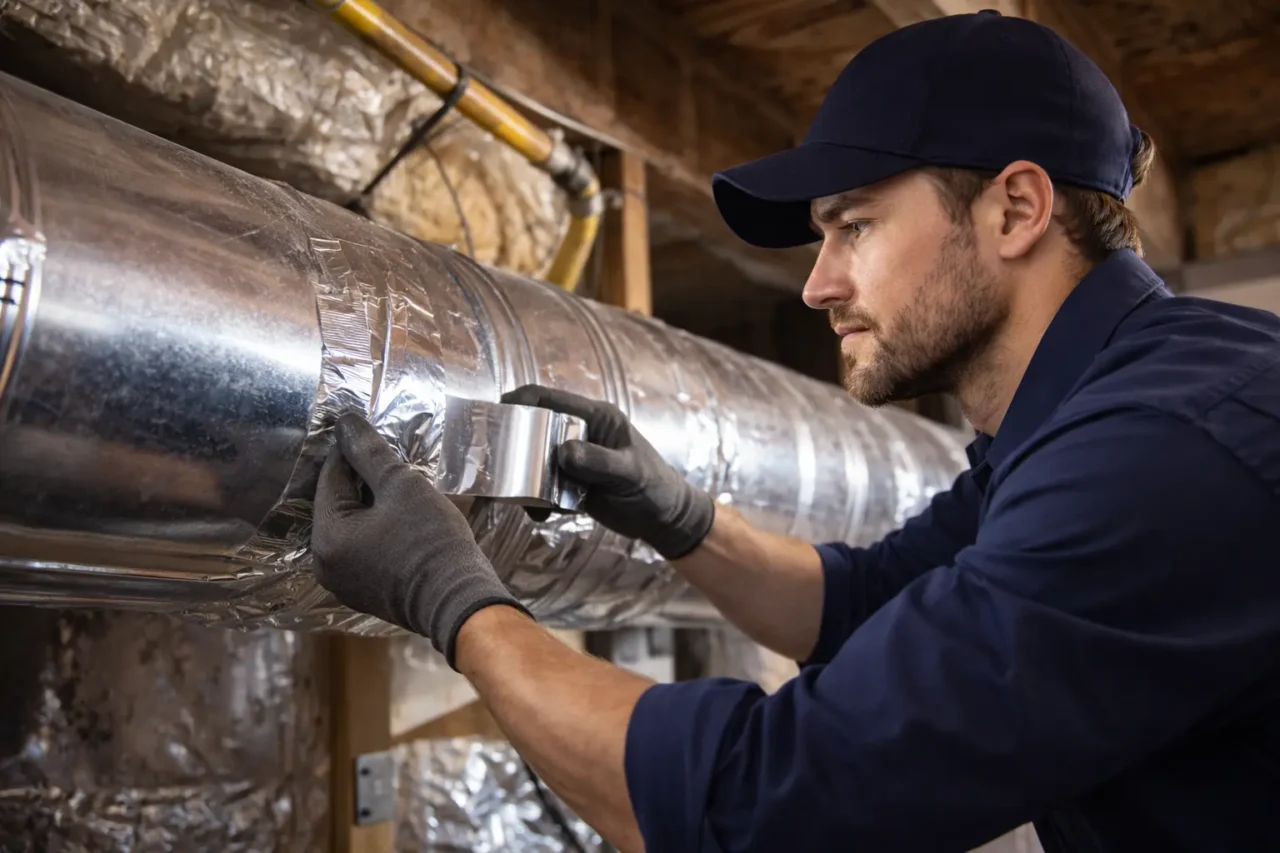
Leaky ducts can waste energy, reduce indoor comfort, and strain your HVAC system. Our air duct sealing services are designed to eliminate these issues by closing gaps, cracks, and loose connections in your ductwork. Proper duct sealing helps your system distribute air more efficiently, improving both performance and energy savings.
If you notice uneven temperatures, high utility bills, or poor airflow, it may be time for hvac duct sealing. Our technicians use advanced methods and materials to ensure long-lasting ac duct sealing that reduces air leaks and improves indoor air quality.
Beyond boosting efficiency, air duct sealing can help reduce dust and allergens circulating in your home. It also decreases wear and tear on your HVAC system, potentially extending its lifespan. The duct sealing cost is a smart investment, often paying off in lower energy bills and improved comfort.
Whether you’re dealing with older ductwork or upgrading an existing system, our expert duct sealing services ensure your home stays comfortable year-round with minimal energy waste.
Your message has been sent successfully. We will contact you soon!
Leaky ductwork wastes energy, reduces indoor air quality, and strains your HVAC system. Our expert duct sealing services eliminate leaks to improve airflow and boost system efficiency. With air duct sealing and ac duct sealing, you’ll save energy and enjoy a more comfortable home.
Signs you need duct sealing include:
Our HVAC duct sealing addresses these issues effectively.
We provide thorough air duct cleaning and sealing, ensuring clean and sealed ductwork for better performance. Our services include:
Whether it’s ac duct sealing or full HVAC duct sealing, we ensure lasting results.
Our team delivers precise air duct sealing, ac duct sealing, and HVAC duct sealing using industry-best methods. We ensure clean, sealed ductwork with clear explanations and transparent duct sealing cost. From inspection to final seal, our duct sealing improves HVAC performance and home comfort.
Protect your HVAC system and improve home comfort with expert air duct sealing. Contact us for professional air duct cleaning and sealing, ac duct sealing, or HVAC duct sealing services. Our team guarantees efficient airflow, lower energy bills, and cleaner indoor air.

Most residential duct systems in this region run through an unconditioned attic that reaches well above ambient on a summer afternoon. A supply leak there discharges air the system has already paid to cool into a space nobody occupies. A return leak does something worse: it pulls attic air, with its heat, its humidity and its particulate, directly into the air handler, where the coil then has to remove moisture it was never meant to see.
That is why return-side leakage is the priority. A house with leaking returns runs longer, holds higher indoor humidity, and loads its filter and coil faster than the same house with tight returns, and none of those symptoms point obviously at ductwork.
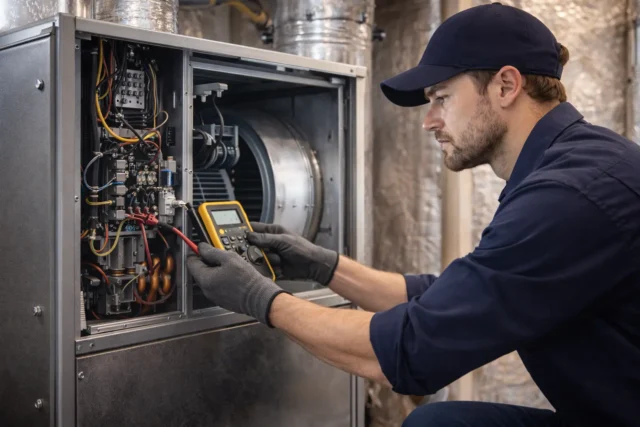
Duct sealing without measurement is guesswork with mastic. The work starts with a pressure test that quantifies total leakage and separates supply from return, combined with static pressure readings either side of the air handler. Those numbers tell you whether the problem is leakage, restriction, or both, and they set the target the sealing has to hit.
Restriction is the failure that gets mistaken for leakage. A system with high static pressure from undersized returns, a collapsed flex run or a loaded coil moves too little air, and sealing a system like that without correcting the restriction makes the pressure problem worse. The test tells you which conversation you are having.
Accessible joints are sealed mechanically: mastic and mesh at plenum transitions, takeoffs, boots and connections, with the flex properly supported and the inner liner drawn tight rather than left sagging. Boot-to-drywall penetrations are sealed at the ceiling, because that interface is a significant share of total leakage in this construction type and it is routinely skipped.
Cloth-backed duct tape is not a sealing material on ductwork. It fails from the adhesive outward in attic heat, usually within a few seasons, and a system sealed with it will test as leaking again well before anyone expects to revisit it.
A sealed system is verified, not assumed. Static pressure is re-read, airflow is measured, and the temperature split across the coil is checked to confirm the system is moving what it was designed to move. The comfort change people notice is usually in the rooms furthest from the air handler, where a long run that was losing pressure to leaks finally delivers, and in indoor humidity, which falls once the return stops drawing attic air.
Attic duct runs leak hardest where the attic is unconditioned and the house is single-storey, which describes most of Coconut Creek and Cooper City. In Plantation and Oakland Park the ducts are older still, and a system that looks undersized usually is not.
The three things worth reading first: why cleaning is not sealing, what actually holds on a joint and where a house loses its conditioned air.
A supply leak wastes conditioned air into the attic. A return leak pulls attic air, with its heat, humidity and particulate, straight into the air handler, so the coil has to remove moisture it was never meant to see. The house runs longer and stays damper.
No. Cloth-backed tape fails from the adhesive outward in attic heat, usually within a few seasons. Sealing is done with mastic and mesh at joints, takeoffs, boots and plenum transitions.
The same way the leakage was found. Static pressure is re-read either side of the air handler, airflow is measured, and the temperature split across the coil is checked. Those readings are the proof, not a verbal assurance.
In an unconditioned attic, enough to matter, and the honest answer is that nobody knows for your house until it is measured. We take the reading before the work and again afterwards, so the difference is a number you can see rather than a claim you have to accept.
Sealing, in almost every case. Cleaning removes what has settled; sealing stops the duct pulling in more, and a sealed system stays cleaner as a side effect.
In most houses, yes. The plenum, the boots and the accessible joints carry the majority of the loss, and all three are reachable without opening ceilings.
 English
  Français
  Español
  Русский