Your message has been sent successfully. We will contact you soon!

Your message has been sent successfully. We will contact you soon!

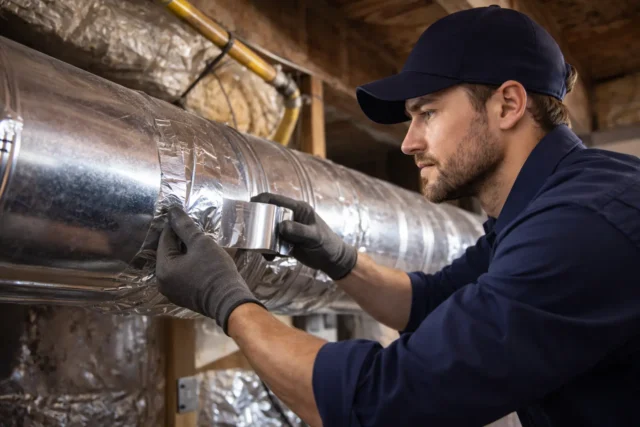
A legitimate air duct cleaning service puts the system under negative pressure with a collection unit, then agitates each run mechanically with brushes or compressed-air tools so debris travels to the collector rather than into the house. Every supply and return is done, the plenums are addressed, and the blower compartment and the coil face are cleaned, because those are where loading actually restricts airflow. A vacuum held at the register grille moves the dust you can see and nothing beyond the first few feet.
What duct cleaning does not do is worth stating plainly. It does not fix a duct system that leaks, it does not correct undersized returns, and it does not resolve a humidity problem. Those are separate faults with separate remedies, and selling a cleaning as the answer to any of them is how this trade earned its reputation.
The honest triggers are visible microbial growth on the coil or the interior duct surface, an infestation, debris left by renovation or roofing work, ducts that were open during construction, an odour that persists after the coil and the drain pan have been cleaned, or a move into a property with unknown history. Routine cleaning on a fixed interval, in a house with none of those conditions, changes very little.
In this market the coil and the drain pan matter more than the duct run. Duct runs here are often short, and a wet coil in a warm air handler closet grows what it grows regardless of how clean the sheet metal downstream is. Any assessment that does not start at the coil is looking in the wrong place.
Dryer vent cleaning is often booked alongside air duct cleaning and shares almost nothing with it. The reason is fire risk and appliance efficiency, not indoor air quality. Lint accumulates in the duct and at the exterior termination, drying times climb, and the appliance runs hotter than it was designed to. Long runs, flexible foil transitions and terminations with damaged flaps are the conditions that accelerate it, and all three are common in this region's housing stock.
Residential air duct cleaning is a half-day to a day depending on system count and access. Commercial air duct cleaning is scoped differently: more runs, ceiling access that has to be coordinated with tenants, and in food service or medical settings a documentation requirement that the residential side does not have. The deliverable there is the before-and-after record per run, not a verbal assurance at the end.
A quote that prices by the vent should say what counts as a vent and whether returns, plenums, the blower compartment and the coil are included. A quote priced per system should say how many systems the property has. Headline offers that advertise a whole house for a token amount are advertising the arrival, not the work, and the scope that turns up is almost never the scope described. Ask which of those items is in the number before anyone is booked.
The calls worth taking come from Plantation and Coral Springs, where mature landscaping and old flex duct meet, and from Miami Lakes, where the lakes keep the latent load high and a damp duct stays damp.
Before booking it is worth knowing what duct cleaning actually changes, what it costs in Florida and what the registers themselves are doing.
Visible growth on the coil or the duct interior, an infestation, debris from renovation or roofing, ducts left open during construction, or an odour that survives cleaning the coil and the drain pan. Without one of those, a routine interval changes very little.
Every supply and return, both plenums, the blower compartment and the coil face, with the system under negative pressure and each run agitated mechanically. If a quote does not say whether returns, plenums, the blower and the coil are in it, that is the question to ask before booking.
It is a separate service with a separate reason. Duct cleaning is about what the system circulates. Dryer vent cleaning is about lint accumulation, drying times and fire risk, and it runs on its own schedule.
No, and we will say so. It is worth doing after construction work, after a rodent, when there is visible growth at a register, or when a smell returns each time the blower starts.
Rarely. A duct that stops leaking does, and that is a different job with a different quote.
By looking. We open an access panel or pull a register and show you what is in there, because a photograph of somebody else's duct proves nothing about yours.