Your message has been sent successfully. We will contact you soon!

Your message has been sent successfully. We will contact you soon!

Ten to twelve months of runtime a year, salt in the air within a few miles of the coast, and afternoon humidity that keeps coils wet. Those three conditions decide what an AC repair service in this market spends its time on, and the list is shorter than most homeowners expect.
Run and start capacitors drift out of tolerance long before they fail outright, and a capacitor replacement done at the first measurable drift prevents the hard-start that kills compressors. Contactor points pit and weld. Condenser fan motors seize after their bearings take enough salt. Evaporator coils develop formicary corrosion from indoor air chemistry and lose refrigerant slowly enough that nobody notices until capacity drops in August. Condensate lines block, float switches trip, and the system shuts down correctly to protect the ceiling below it.
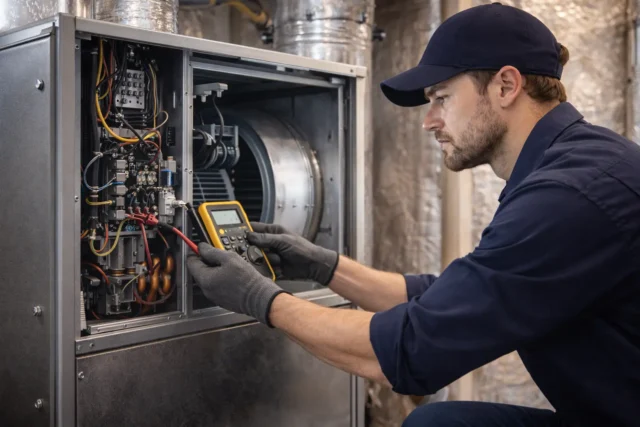
A compressor is the one component where a wrong call is expensive in both directions. It is confirmed with measurements, not symptoms: winding resistance and continuity to ground, amp draw against locked-rotor rating, and whether the unit will start on a hard-start assist at all. A compressor that is merely struggling against a failed capacitor or a restricted condenser reads very differently from one that is electrically dead.
When the compressor has genuinely failed, the next question is not the cost of the compressor. It is the age of the system, the refrigerant it runs on, and the condition of the coil it is paired with. Replacing a compressor inside a fifteen-year-old machine with a corroded coil buys a season at best. That answer gets said out loud even when it loses the job.
Central air conditioning repair, ductless AC repair and packaged rooftop work are separate disciplines that happen to share a refrigerant circuit. A ductless mini split fails at the indoor blower wheel, the control board and the line-set flare joints far more often than a central system does, and it is diagnosed through the manufacturer's error codes rather than at the thermostat. A packaged unit on a roof puts everything in one cabinet and every fault within reach of the weather. We work on all three, and the technician sent to a mini split is not the one guessing at the code list on arrival.
A second opinion is worth asking for whenever the recommendation is a full replacement, a compressor, or a repeat refrigerant charge. A system that has been topped up twice in two summers has a leak that nobody has located, and adding refrigerant to it a third time is not a repair. We will confirm another contractor's diagnosis or contradict it, with the measurements written down either way.
A repair starts with a measurement, not a guess. Charge against the manufacturer's target, amp draw at the compressor and the blower, static pressure either side of the air handler, and the capacitor read before it drifts out of tolerance. Only then does anyone know which fault this is. The same complaint - the house will not cool - comes from at least five unrelated causes, and they do not cost the same to put right. Guessing between them is how a homeowner ends up paying for two visits.
Warm air from the vents. A system that runs all afternoon without reaching the setpoint. Water around the air handler, or a stain on the ceiling below it. A breaker that trips on the hottest day. A noise that started this week and has not stopped. None of these fix themselves, and most get more expensive the longer they run.
There is a point where a quote stops being honest. Fifteen years old, compressor gone, coil eaten by salt: a new compressor there buys a machine that fails somewhere else before the next summer. We say that out loud and lose the job.
We work across Broward, Miami-Dade and Palm Beach, from Fort Lauderdale and Hollywood to Miami, Pembroke Pines and West Palm Beach.
A system that stopped in August is a different conversation from one that needs a part next week. That one is on the emergency AC repair page.
Most of what we are called out to is described somewhere on the blog: the signs a system is failing, the contactor that stops half of them and what a repair actually costs here.
By measurement, not by symptom. Winding resistance and continuity to ground, amp draw against the locked-rotor rating, and whether the unit starts on a hard-start assist. A compressor struggling against a failed capacitor or a blocked condenser reads very differently from one that is electrically dead.
No. A sealed system does not consume refrigerant. Two top-ups in two seasons means a leak nobody has located, and adding a third charge is not a repair. The leak gets found with a detector and a pressure test first.
Yes, and they are diagnosed differently. A mini split reports through the manufacturer's error codes and fails most often at the indoor blower wheel, the control board or the line-set flare joints, so the fault is read from the equipment rather than guessed at from the thermostat.
There is a diagnostic fee and you hear it on the phone before anyone is dispatched. It covers the time to find the fault with instruments rather than guess at it from the symptom, and it comes off the repair if you go ahead with the work on the same visit.
Yes. We service every residential brand sold in this market, and where a part is proprietary we tell you the lead time honestly rather than after you have waited for it.
Age, what failed and what else is tired. A fifteen-year-old system with a dead compressor and a corroded coil is not a repair candidate, and we say so instead of taking the work.