Your message has been sent successfully. We will contact you soon!

Your message has been sent successfully. We will contact you soon!

A new air conditioning installation is judged by what surrounds the box, not by the box. Line set condition and whether it can be reused with the new refrigerant, the condensate path and its safety switch, the disconnect and breaker sizing, the pad and hurricane straps, the return path the new blower has to pull through, and the seal at the plenum transitions. A high-efficiency system installed onto ducts that cannot carry its airflow will underperform a cheaper unit installed properly, and it will do it while the homeowner pays for the efficiency on paper.
Sizing comes before any of that. A load calculation accounts for orientation, glazing, insulation, infiltration and the latent load that Florida humidity adds, and it routinely lands on a smaller system than the one being replaced. Oversizing is the most common installation error in this market: the unit satisfies the thermostat quickly, shuts off before it has removed moisture, and leaves a house that is cold and damp at the same time.
A central AC installation replaces condenser, air handler and often the coil as a matched set, because mismatched components void ratings and warranties. Ductless AC installation puts the capacity where the ductwork cannot reach, which in this market usually means an addition, a converted garage, a Florida room or a primary suite that has never kept up with the rest of the house. A split unit installation for a single zone is a smaller job than a whole-home changeout, and the two get quoted differently because the work is genuinely different.
Where both are viable, the deciding factors are the state of the existing ducts, whether the house has room for a modern air handler, and whether the household wants zone-by-zone control. That conversation happens before equipment is selected, not after.
An AC surge protector at the disconnect is inexpensive insurance in a region that leads the country in lightning density, and modern variable-speed equipment is far more sensitive to voltage events than the single-stage machines it replaces. Control boards and inverter drives are the components that fail after a grid event, and neither is a stocked part. Installing a surge protector for the AC unit at changeout costs a fraction of the board it protects and takes minutes while the circuit is already open.
A changeout in Broward, Miami-Dade and Palm Beach requires a permit and a mechanical inspection. It is not a formality: the permit record is what proves to an insurer and to a future buyer that the equipment was installed to code and strapped for wind load. Work done without one tends to surface at the worst moment, during a claim or a sale. The permit is pulled in the contractor's name and the inspection is scheduled as part of the job, not left with the homeowner.
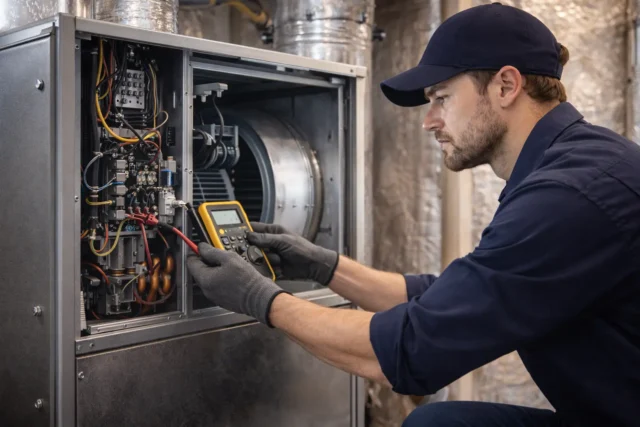
A straight changeout on an accessible system is a single working day. Add time when the air handler sits in a tight closet or an attic, when the ductwork needs modification to carry the new airflow, when electrical has to be brought up to current code, or when a condo board controls access to the roof or the service elevator. The crew protects the route, removes and recovers the old refrigerant to regulation, and leaves the system commissioned with measured pressures, airflow and temperature split recorded rather than assumed.
Installation work clusters near the water. In Dania Beach and Sunny Isles Beach the coil coating and the placement decide whether a system lasts eight years or fifteen. Inland, in North Miami and Miami Gardens, the question is usually whether the ductwork can carry what the new unit produces.
Three questions come up on nearly every replacement, and each has a page of its own: what size the house needs, which equipment lasts in this climate and what a replacement runs to in Florida.
By the state of the existing ductwork, whether the house has room for a modern air handler, and whether the household wants zone-by-zone control. Ductless earns its place where ducts cannot reach: an addition, a converted garage, a Florida room, a suite that never keeps up.
In this region, yes. Variable-speed equipment fails at the control board and the inverter drive after a voltage event, and neither is a stocked part. Fitting the protector at the disconnect takes minutes while the circuit is already open.
Refrigerant pressures against the manufacturer's target for the conditions, airflow measured rather than assumed, static pressure either side of the air handler, and the temperature split recorded. Those numbers are the proof the system was installed correctly, and they are left with you.
One day for a straight replacement in most houses. Add a day if the ductwork is being reworked or the electrical needs upgrading, and we tell you which of those applies before the work is booked.
Yes, and we pull it. A changeout done without one becomes the seller's problem at closing.
No. An oversized system reaches the temperature before it has removed any moisture, shuts off, and leaves the house cool and damp. We size for the load, which in this climate is mostly a moisture calculation.
 English
 Français
 Español
 Русский