English
  Français
  Español
  Русский


New AC unit cost in Florida varies more than most homeowners expect, and the spread is real. The same home can draw very different quotes depending on the system tier, the condition of the existing ductwork, and how the contractor sizes the job.
What follows covers the equipment and the whole replacement job: what the box costs, what moves that number, how a first-time ducted installation is priced, and where permits and county rules change the quote.
Most pricing articles online throw out a national average and stop there, which is useless when you are budgeting for a real replacement in South Florida. What actually moves the number is the equipment tier, the efficiency rating, and everything around the install – and none of it appears in an average.
Below is what really drives the price, what is negotiable, and where contractors cut corners to make a bid look cheaper than it is. If you are still weighing fixing the old system, our breakdown of what goes into an AC repair bill in Florida covers the other side of that decision.
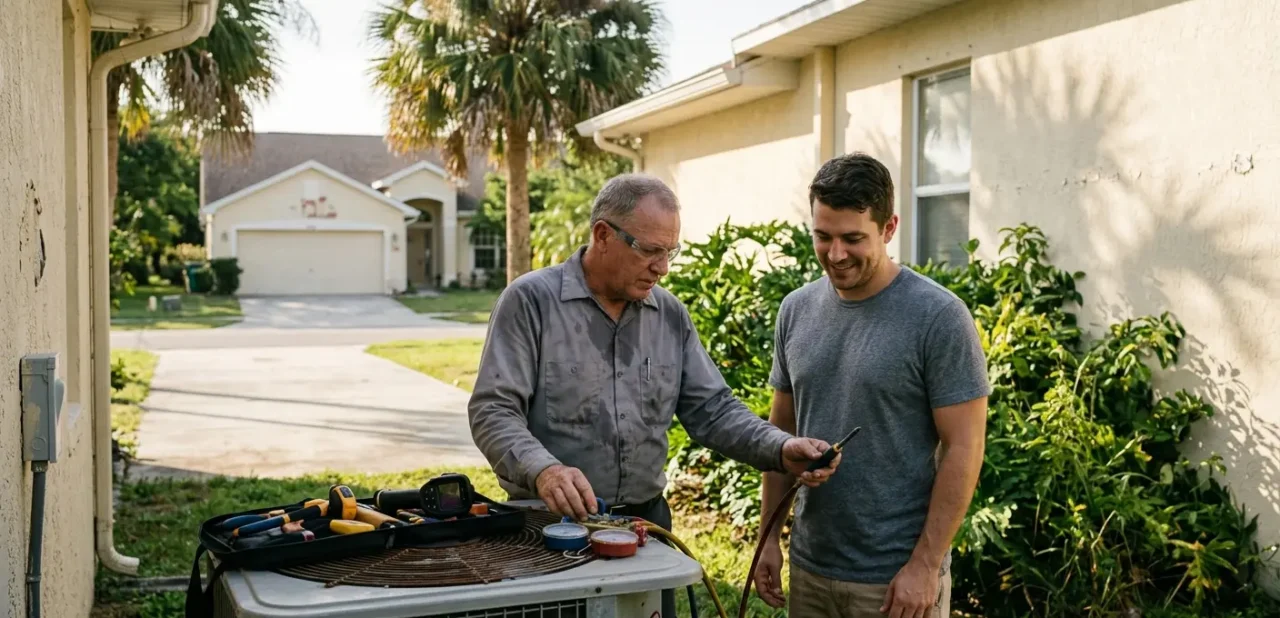
What a replacement runs comes down to things no spec sheet shows: duct condition, electrical, permits, access. We check all of it in person, anywhere in Florida.
What You’re Actually Paying For When You Buy a New AC
A lot of homeowners picture a single box that sits outside the house. A complete installation has several parts, and understanding each one helps you compare quotes without getting taken for a ride.
The outdoor condenser is what most people picture as the air conditioner. It holds the compressor, condenser coil, and fan, and the compressor type inside it is the single biggest driver of both comfort and price.
Inside the house is the air handler. Florida homes almost never use furnaces, so the air handler is the indoor half of the system – it houses the evaporator coil and blower motor, plus a small set of electric heat strips for the few cold nights. The blower type matters more than most people realize: a variable-speed blower runs quieter, circulates air more evenly, and pulls more moisture on humid days.
The thermostat usually comes bundled in. Upgrading to a smart thermostat is a small add that earns its keep, since the scheduling features trim your FPL bill over a cooling season that runs most of the year.
What Moves the Price Up or Down
Two quotes for the same house can look very different, and the equipment box is rarely the reason. These are the factors that actually set where your number lands.
System tier is first. A budget single-stage unit cools on a full-blast-or-off cycle, which means weaker humidity control and higher running costs. A two-stage or variable-speed system runs longer at lower speed, manages humidity far better, and carries a higher upfront cost. In Florida, where the system runs most of the year, that comfort and efficiency difference is the one most homeowners feel.
Efficiency is second. The federal minimum for our region is 14.3 SEER2 for most residential split systems, roughly 15 on the older SEER scale – the legal floor. Stepping up returns the difference through lower FPL bills, and the longer your cooling season, the faster that adds up.
Want a Real Number for Your Home?
We do a free on-site estimate with a proper load calculation – no guesswork, no obligation.
The Hidden Costs That Change Your Quote
The most common follow-up we hear is why one company quotes far less than another for the same house. Nine times out of ten the difference is not the equipment. It is everything around it.
Ductwork modifications
Florida attics get brutally hot in summer. If your ducts are old, crushed, poorly insulated, or undersized for the new system, they need work, and even partial resealing adds to the job. We find ductwork issues in roughly half the replacements we do, especially in older homes. Some contractors skip this entirely to keep the bid low, and that is how you end up with a brand-new system that cannot deliver air where it needs to go.
Electrical upgrades
If your disconnect box or breaker cannot handle the new system’s amperage, that gets added. Older homes sometimes need a panel upgrade, but it is less common than some contractors make it sound.
Permit and inspection fees
Florida law requires a building permit for any AC replacement. Not optional, not negotiable. The contractor should pull the permit as part of their scope, and if someone offers to skip it to save money, walk away. Unpermitted work stalls home sales when the buyer’s inspector flags it, and it is also a warranty killer – most manufacturers require permitted installation for coverage to apply.
Drain line and safety devices
Condensate drain lines clog constantly in Florida’s humidity. A good contractor includes a new drain line with a safety float switch that shuts the system off before a clogged drain floods your ceiling. The part is inexpensive, the water damage it prevents is not. If it is not on the quote, ask why.
How to Compare Quotes Without Overpaying
Getting three quotes is standard advice, and it is good advice. But knowing what to look for inside those quotes matters more than comparing bottom-line numbers.
Make sure every quote specifies the exact equipment – model numbers rather than brand names. “A 3-ton Trane system” tells you nothing; the specific model and matching air handler let you compare like for like. If the brand choice itself is what has you stuck, our Trane vs Carrier breakdown for Florida homes explains why the coil spec outranks the badge here.
The load calculation is where contractors cut the biggest corner. A proper install starts with a load calculation under ACCA’s Manual J standard that sizes the system from your home’s insulation, window area, orientation, ceiling height, and duct layout – not square footage alone. Oversizing is the most common mistake here: a too-large system short-cycles and never runs long enough to pull humidity out of the air, leaving a cold house that still feels damp.
Warranty is the last piece. Manufacturer parts coverage usually applies only when the system is registered on time and installed by an authorized dealer – a non-authorized installer can void it before you turn the system on. Labor warranty is separate. A professional AC installation backs both the equipment and the workmanship.
When Repair Makes More Sense Than Replacement
Not every AC problem needs a new system. A capacitor or contactor replacement can buy an existing unit several more years. Here is how we think about the line between the two.
- System under about eight years old with a minor repair – fix it
- Repair approaches half the cost of a new system – replace
- Unit past ten years and needing frequent service calls – replace
- Still running R-22 refrigerant – strongly consider replacing
The energy math matters too. Older units run at far lower efficiency than a modern SEER2 system, which means a higher FPL bill every month. And R-22, now banned from new production, only gets harder and costlier to source for a recharge. The supply moves one direction. ENERGY STAR’s guidance on heating and cooling also says to have a professional evaluate equipment that is over 10 years old or no longer keeping the home comfortable.
Single-Stage, Two-Stage, and Variable-Speed: What You’re Choosing Between
The compressor type drives both the upfront cost and the long-term operating expense. Understanding the difference keeps you from overspending on features you don’t need or underspending on a system that won’t keep up.
Single-stage compressors are the straightforward option. Full blast or off. They cost the least upfront and cool the house, but they cycle on and off frequently, which means higher electricity use and less control over indoor humidity.
Two-stage systems spend most of their runtime at a lower speed, only ramping up when the load demands it. That lower speed is where the real advantage lies in Florida – the system runs longer at reduced output, which strips more moisture from the air. For a family home in Fort Lauderdale or Plantation, this is where most of our customers end up landing. Meaningful efficiency gains without the jump to premium pricing.
Variable-speed compressors are a different category entirely. The system modulates output continuously, running at 40% on a mild February morning and 95% during an August afternoon. Here’s what that means in practice:
- Consistent temperature from room to room, even in two-story homes
- Humidity stays where you set it, not where the weather decides
- The outdoor unit runs so quietly that neighbors won’t hear it
- Lowest electricity bills of any compressor type over the life of the system
The upfront cost is higher. But for homeowners in Weston, Parkland, or Boca Raton who plan to stay long-term, the electricity savings and comfort difference tend to justify the investment within a few years.
Ducted Central Air vs Ductless and What It Means for Your Quote
Most Florida homes run ducted central air, where one system feeds conditioned air through ducts to every room. When the ductwork is already there and sound, this is usually the most direct path.
Homes without ducts tell a different story, and so do additions, garage conversions, and older block houses. A ductless mini split setup skips the duct cost entirely and cools room by room. That can flip the math when building duct runs from scratch would otherwise dominate the project.
Neither option is automatically cheaper. The right one depends on what your home already has.
Permits, Code, and County Differences
Florida requires a permit for central air installation. The contractor pulls it, the work gets inspected, and the paperwork protects you when you sell the home later. On a new build the permit is only one item among many, and what to get right first in a new-construction HVAC plan is its own subject.
Broward, Miami-Dade, and Palm Beach each run separate fee schedules and inspection processes. A job in Boca Raton follows a different permit path than the same job in Miami Gardens.
Miami-Dade carries the strictest requirements, again because of the High-Velocity Hurricane Zone. Outdoor equipment must be anchored to approved standards, and the inspector verifies those tie-downs before the system passes. This is not the place to let a contractor cut corners.
Skipping the permit to shave the figure is a false saving.
Unpermitted equipment surfaces during a home sale and during insurance claims after a storm, and it costs far more to untangle then than it ever saved at install.
Financing and Utility Rebates in Florida
Most HVAC companies in South Florida work with financing partners that offer promotional rates. Equal monthly payments over 36 to 60 months at low or zero interest are common. The key is confirming whether the offer is true 0% APR or deferred interest – with deferred interest, missing the payoff deadline triggers retroactive charges at rates above 20%.
FPL and other Florida utilities periodically offer rebates on high-efficiency equipment. The amounts change, but qualifying systems rated 16 SEER2 or higher have historically been eligible. Checking with your utility before signing a contract takes five minutes and can save real money.
Get the Scope in Writing
We visit the property, inspect what you already have, and give you a clear, obligation-free quote for the installation. No pressure to commit.
FAQ
What drives the cost of a new AC unit in Florida?
Three things, mostly. The system tier and compressor type, the SEER2 efficiency rating, and the work around the equipment – ductwork condition, any electrical updates, and the county permit. Two homes the same size can land far apart once ductwork and load are factored in.
What size AC unit do I need for my Florida home?
That depends on a Manual J load calculation, not square footage alone. A rough guide is one ton per 500-600 square feet, but insulation, window count, ceiling height, attic ductwork, and which way the house faces all change the math. Oversizing is worse than undersizing in Florida – a too-large unit short-cycles and never runs long enough to pull humidity from the air, leaving a cold house that still feels damp.
Is it worth upgrading to a higher SEER2 rating in Florida?
Almost always. With AC running most of the year, the efficiency gap shows up on every FPL bill, so a higher rating pays itself back over the system’s life and keeps saving after that. For a homeowner planning to stay, it is one of the easier upgrades to justify.
Do I need a permit to replace my AC in Florida?
Yes. No exceptions. Florida requires a building permit for any HVAC replacement, and the work must pass a county inspection. Skipping it risks your warranty and can stall a future home sale.
How long does a new AC unit last in Florida?
Well over a decade with proper maintenance. Budget units near the coast can start failing sooner from salt air corrosion. The biggest factors are how often you service it, how close you are to saltwater, and whether the system was sized correctly for the home.
Why do two contractors quote such different prices for the same house?
Usually the difference is scope, not equipment. A lower quote may leave out ductwork repairs, a load calculation, a new drain line, or factory-authorized installation. Itemized quotes that name the exact equipment and the work included are the only way to compare fairly.