Your message has been sent successfully. We will contact you soon!
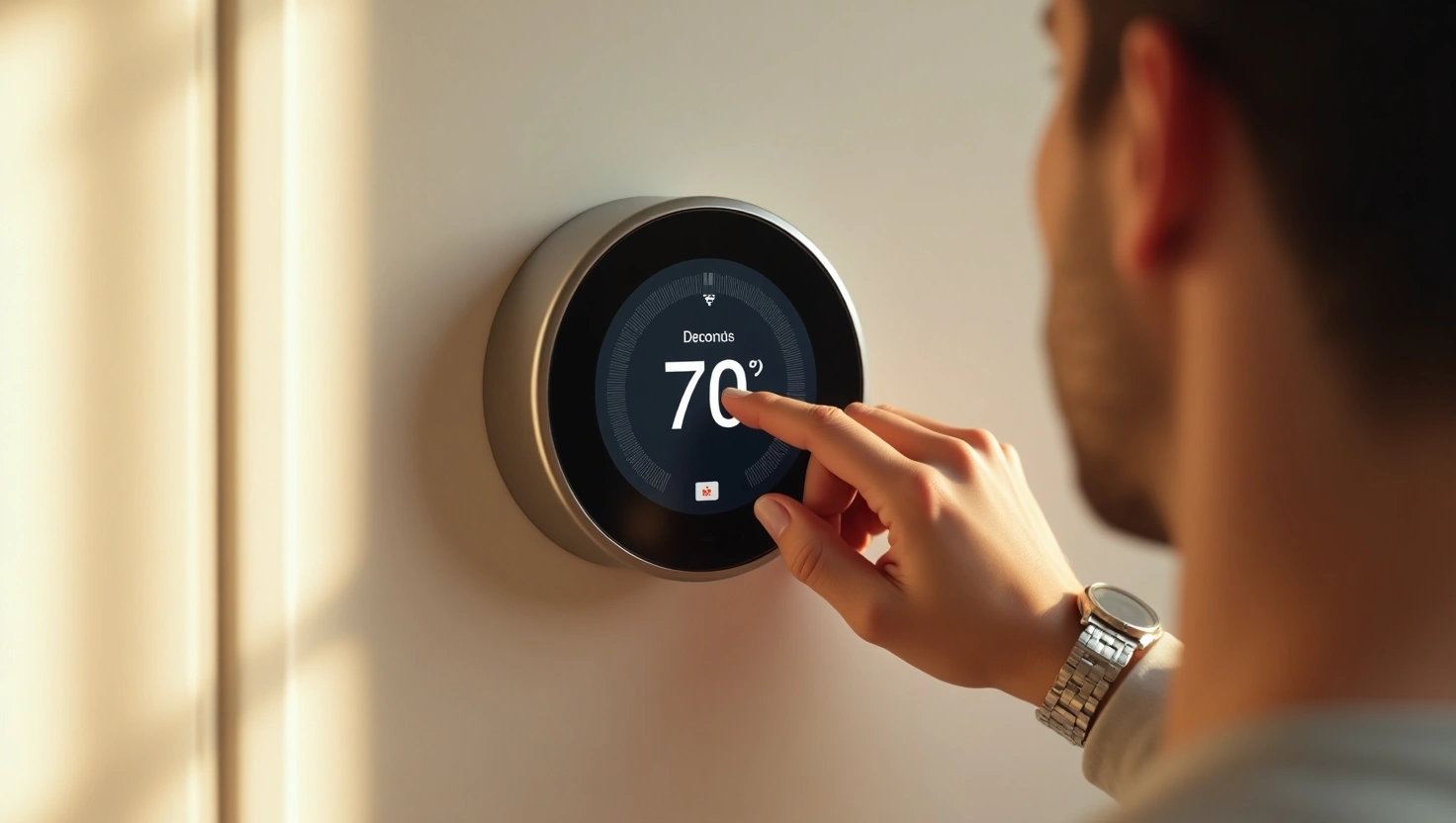
A properly working thermostat keeps your home comfortable and your HVAC system efficient. Our professional thermostat services ensure your heating and cooling respond exactly how you require. Whether your unit is outdated, unresponsive, or inaccurate, our expert thermostat technician can quickly diagnose and solve the problem.
We offer complete thermostat replacement and thermostat repair services for all major brands, including smart thermostats and programmable models. If you notice inconsistent temperatures, rising energy bills, or a thermostat that doesn’t communicate well with your system, it’s time to call us.
Our thermostat installation service helps upgrade your home to the latest technology. We install both traditional and WI-Fi-enabled models, giving you better control over indoor comfort and energy use. Our technicians handle wiring, setup, and calibration to ensure seamless operation.
From simple repairs to full thermostat replacement, we make sure your system works reliably and efficiently. Trust our thermostat technician to improve comfort and lower costs with fast, dependable thermostat services.
Your message has been sent successfully. We will contact you soon!
A properly functioning thermostat is essential for maintaining a comfortable indoor climate and controlling energy costs. Our professional thermostat services include installation, repair, and replacement to keep your HVAC system working efficiently and your home comfortable year-round.
If your thermostat is not working correctly, it’s time to call a thermostat technician. You may need thermostat repair if:
Our thermostat repair services diagnose and fix issues quickly to restore smooth operation.
Our complete thermostat installation covers:
Whether you require standard HVAC thermostat installation or advanced HVAC nest installation, our thermostat technician ensures everything runs perfectly.
Thermostat replacement is recommended when:
Our team handles both house thermostat replacement and HVAC thermostat replacement to enhance efficiency and comfort.
We offer expert thermostat repair, installation, and replacement with certified thermostat technicians. Our team ensures accurate HVAC thermostat wiring, seamless installation, and thorough testing. Whether you need HVAC thermostat repair, HVAC thermostat replacement cost info, or a full HVAC nest installation - we provide dependable service at fair prices.
Ensure your home’s comfort and efficiency. Contact us to schedule thermostat installation service, thermostat repair services, or thermostat replacement. We provide fast, affordable thermostat services you can trust.

A thermostat is a control, not a source of capacity. It will not make an undersized system cool a house, it will not dry out a home whose duct returns are pulling attic air, and it will not rescue a system with a refrigerant leak. What it does change is scheduling, staging behaviour on modern equipment, and the quality of the data available when something goes wrong.
That distinction matters because a smart thermostat is frequently sold as the answer to a comfort problem it cannot touch. Where the complaint is high humidity, uneven rooms or a system that runs constantly, the thermostat is the last thing to change, not the first.
Most smart thermostats need a common wire to power themselves continuously. Older Florida homes frequently have four conductors at the wall and no common, and the workarounds vary in quality: some manufacturers supply a power extender at the air handler, some models run on batteries with reduced function, and pulling a new cable is sometimes simpler than either. A smart thermostat installed without a stable supply will drop offline, lose schedules and, on some equipment, chatter the relay.
Compatibility is the second question and it is equipment-specific. Multi-stage systems, heat pumps with auxiliary heat, communicating systems that use a proprietary bus, and ductless heads that expect their own controller all place limits on what a third-party thermostat can do. A communicating system in particular will lose features if a generic thermostat replaces the manufacturer's control.
A programmable thermostat follows a schedule you set. A smart thermostat adds remote access, occupancy or geofencing logic, and usage reporting. A communicating control talks to the equipment on its own protocol and can stage compressor and blower with far more precision than any relay-based control, which is why a variable-speed system paired with a generic thermostat behaves like a single-stage one.
For this climate, the feature worth more than scheduling is humidity control. A thermostat with a genuine dehumidification mode can slow the blower to increase moisture removal, or call for cooling on humidity rather than temperature alone. On a system that supports it, that single capability addresses the complaint most Florida households actually have.
A thermostat reports the temperature at one point on one wall. Put it on an exterior wall, in a hallway with a supply register blowing at it, in direct sun through a window at four in the afternoon, or over a lamp, and it will call for cooling the rest of the house does not need. Relocation is frequently the entire repair when the complaint is a system that cycles oddly or a house that is cold in one zone and warm in another.
Thermostats come up wherever the system is zoned or the building is not. Parkland and Weston run two systems in one house and need both to agree; Hallandale Beach runs a heat strip a few nights a year and needs a thermostat that knows the difference.
Choosing one and living with it are separate questions: which wifi thermostat is worth it and how to program the one you have.
A power extender at the air handler, a model that runs reduced function on batteries, or pulling a new cable. Which is right depends on the equipment and the run, and pulling cable is sometimes the simpler of the three rather than the last resort.
It changes scheduling and gives you usage data. It adds no capacity and fixes no fault. Where the complaint is humidity, uneven rooms or a system that runs constantly, the cause is elsewhere and the thermostat will not reach it.
In this climate it is the feature that matters most. A genuine dehumidification mode can slow the blower to increase moisture removal or call for cooling on humidity rather than temperature, provided the equipment supports it.
A little, and mostly through the schedule rather than the device itself.
Usually wiring. A missing common wire, or a heat pump configured as a conventional system, produces exactly that behaviour and it is a settings problem rather than a fault.
Often, yes. Where it goes wrong is a system with a heat strip or two stages, because a thermostat configured for the wrong equipment can run the heat and the cooling together.
 English
  Français
  Español
  Русский