English
  Français
  Español
  Русский


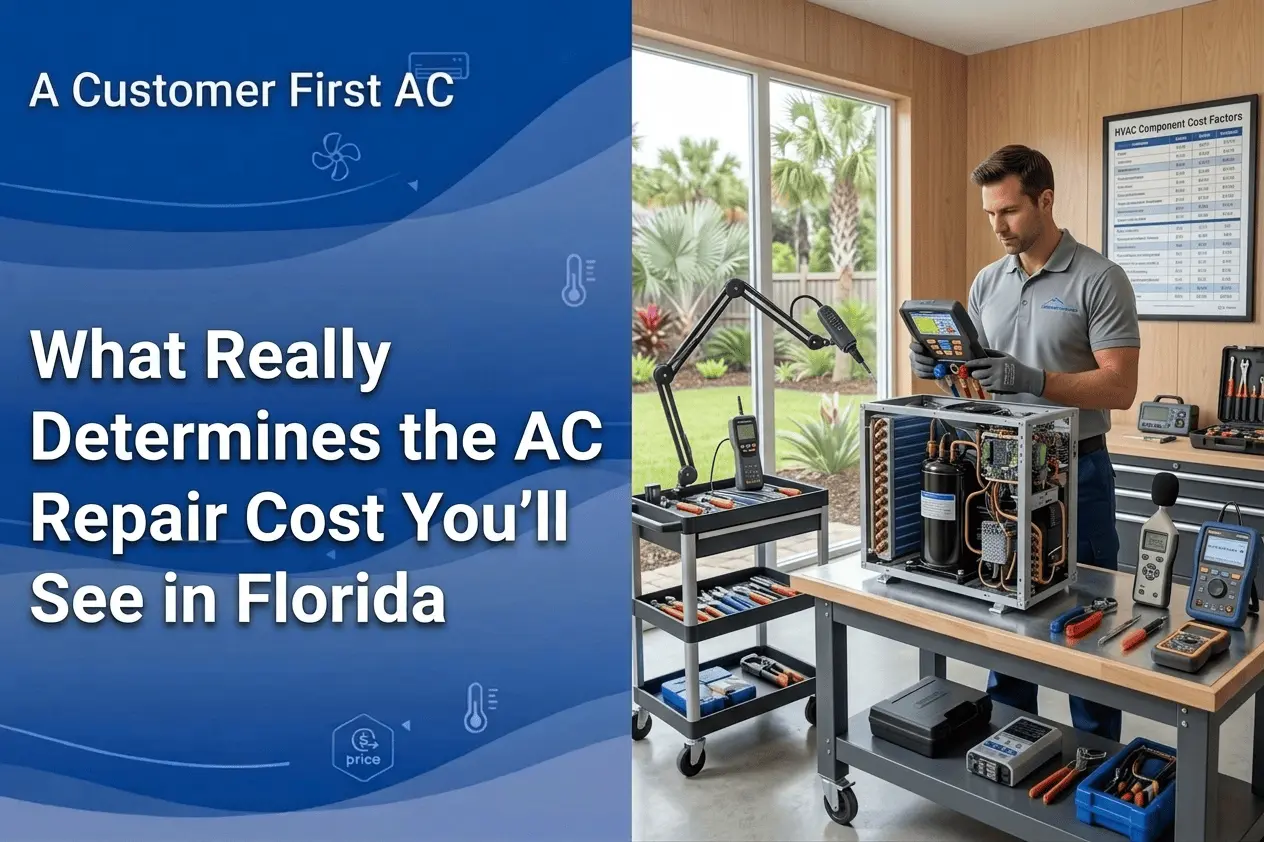
AC repair cost in Florida varies more than in almost any other state. The same symptom can point to a low-cost electrical fix or to a major refrigerant-circuit repair, and no honest number exists without an on-site diagnostic.
What follows is a clear breakdown of what actually shapes a Florida AC repair bill. Each section covers a real cost driver, from component type to refrigerant choice to seasonal timing.
If repair vs replacement is already on the table, our breakdown of what AC replacement runs in Florida right now covers the other side of that decision.
Why a Single Repair Price Doesn’t Exist in Florida
National AC repair averages blend mild-climate states with high-load regions. Florida systems run ten to twelve months a year, which changes wear patterns, failure rates, and parts availability.
The same complaint – “the AC isn’t cooling” – can be a labor-only drain clog, a capacitor swap, or a compressor on its last legs. The price gap between those outcomes is significant. If you are still trying to pin down the symptom, our guide on an AC that runs but will not cool covers what to check before you call.
Until a licensed technician evaluates the system, any quote given over the phone is a guess. The real number comes from the diagnosis.
What Actually Goes Into Your AC Repair Bill
Every repair quote in Florida is built from five core variables. How they line up against your system determines where the final number lands.
Type of failure
This is the largest single driver. Electrical components like capacitors, contactors, fuses, and thermostats are inexpensive parts with short labor times. Refrigerant-circuit work – leaks, coil replacements, compressor swaps, TXV failures – involves recovery, vacuum, recharge, and pressure testing, which extends labor and adds material cost.
Parts versus labor hours
Some repairs are part-heavy. Others are labor-heavy. A blower motor swap is mostly the part cost. Diagnosing an intermittent fault that only appears under peak load is mostly labor.
System age and parts availability
Equipment older than ten years often loses access to original OEM parts. Substitute components may be available, but lead times stretch and pricing fluctuates depending on what’s in stock locally. Systems past the twelve-year mark increasingly run into this constraint.
Warranty status
Manufacturer warranty covers the failed part for a defined period – typically ten years on registered systems. It does not cover the labor to install the replacement.
Labor warranty is a separate product purchased at installation. Many homeowners forget they have one. Verifying both before approving a major repair is standard practice.
Service timing
After-hours, weekend, and holiday calls carry a premium across every reputable shop. Peak summer demand across South Florida compresses available service windows further. A non-emergency repair scheduled for the next business morning often costs less than the same job dispatched in the evening.
The Repairs South Florida Homes See Most Often
A short list of failures accounts for most service calls across South Florida. Knowing which are quick and which involve refrigerant work helps a homeowner read a technician’s findings.
Capacitor failure
The most common AC service call in Florida. The capacitor stores the energy surge needed to start the compressor and fan motor. Heat is what kills them, which is why they fail on the hottest days of the year.
Replacement is fast and the part is inexpensive. Most systems return to normal operation within the same service visit.
Contactor wear
The contactor is the relay that closes the circuit to power the outdoor unit. Pitted contacts, stuck plungers, and burnt coils are common failure modes. Contactors are often replaced alongside the capacitor since both wear from heat and cycling.
Condensate drain clog
Florida humidity means the evaporator coil pulls gallons of water out of indoor air daily. That water exits through a PVC drain line. Algae and biofilm restrict the line over time.
Once the line clogs, the safety float switch shuts down the system to prevent water damage. The repair is often a simple clearing of the line, sometimes paired with float switch replacement if the switch itself has failed.
Refrigerant leak
Refrigerant is not consumed during normal operation. A low charge always indicates a leak – at a flare fitting, in the coil, along the line set, or inside the compressor itself.
Finding the leak takes time. Sealing it requires recovery of the remaining refrigerant, repair, vacuum, recharge, and pressure testing. Adding refrigerant without locating the source is a short-term measure that returns the same problem within the season.
Our refrigerant leak repair service follows the full leak-search and seal procedure rather than topping off the system. Recovery and pressure testing are required steps under federal refrigerant handling rules.
Blower motor and condenser fan motor
The indoor blower moves conditioned air through the ductwork. The outdoor fan dissipates heat from the condenser coil. When either fails, the symptom presents as poor airflow or no cooling.
Motor replacement is a mid-range repair. Cost depends on whether the failed motor was an OEM unit or a universal motor with a separate run capacitor.
Evaporator coil corrosion
This failure mode is more common in coastal homes. Formic acid from indoor air, combined with salt and humidity east of US-1, creates pinhole leaks in the thin copper of the evaporator coil. Once the coil leaks, the repair is replacement, not patching.
Coil replacement involves refrigerant recovery, removal of the failed coil, installation of the new coil, vacuum, and recharge. Labor is the largest line item.
Compressor failure
The compressor is the highest-cost single component in a residential AC system. When it fails, the repair-versus-replace decision is forced.
On a younger system within manufacturer warranty, compressor-only replacement can be reasonable. On a unit ten or more years old, the math typically favors a full system replacement.
Want a Real Number for Your Repair?
Pricing depends on the diagnosis. Schedule an on-site visit for a written quote with no surprises.
Refrigerant Type Has a Direct Effect on Repair Cost
Three refrigerants are relevant to current Florida residential service calls.
R-22 has not been produced in the United States since 2020. Any leak repair on an R-22 system requires recovered or stockpiled supply, which carries scarcity pricing. Recharging an R-22 leaker is rarely cost-effective.
R-410A is the refrigerant in most systems installed between roughly 2010 and 2024. Supply remains stable and pricing is predictable for standard leak repairs.
R-454B is the new A2L refrigerant adopted by manufacturers for residential systems starting in 2025. The transition was driven by the federal low-GWP refrigerant policy.
R-454B is mildly flammable. It requires updated handling procedures, A2L-rated leak detection, and certified technicians. Until the supply chain matures, repairs involving R-454B charges carry higher material and labor cost compared to equivalent R-410A work.
The refrigerant inside your system directly influences the cost of any leak repair. Identifying it is part of the technician’s initial inspection. The EPA’s Section 608 page notes that the Clean Air Act bans intentionally venting refrigerant while servicing or repairing air conditioning equipment.
Hurricane Season and Salt Air as Cost Drivers
South Florida systems face two regional stress factors that affect repair frequency and cost.
Power surges from summer storms damage capacitors, contactors, and control boards. Lightning strikes near a home can disable an outdoor unit entirely. Post-storm debris and floodwater introduce additional failure modes.
Salt air is the slower factor. Aluminum condenser coil fins corrode and crumble. Copper line sets pit over time. Outdoor cabinets rust through at the base where condensation collects.
Coastal homes within a few miles of the Atlantic see coil failures and motor replacements at noticeably shorter intervals than inland properties. A system that lasts well inland may need coil replacement years sooner just a few blocks from the water.
Service Call, Diagnostic, and After-Hours Charges
Terminology varies between shops, which causes confusion on quotes.
A service call fee covers vehicle dispatch to the property. A diagnostic fee covers the technician’s time identifying the fault. Many shops bundle both into a single number. Reputable contractors credit or waive these fees when the homeowner approves the repair on the same visit.
After-hours, weekend, and holiday service carries a documented premium. The premium reflects technician overtime and unscheduled dispatch. Emergency service exists for medical and safety situations where waiting until the next business day is not viable.
Quotes are structured as either flat-rate or time-and-materials. Flat-rate guarantees a fixed price regardless of completion time. Time-and-materials charges by the hour plus parts.
Both billing models are legitimate. Confirming the structure before authorization is standard practice.
When the Math Tips Toward Replacement
Repair is the appropriate path on most failures. A small set of conditions shifts the analysis toward replacement instead.
Equipment age is the first signal. Systems older than ten or twelve years operate well past their efficiency prime, and Florida run-times accelerate that wear.
The failure type matters next. Capacitors, contactors, and drain clogs are reasonable repairs on older systems. Compressor or evaporator coil failures on the same equipment generally favor replacement.
Older systems running 10 SEER or 12 SEER also fail the efficiency comparison against today’s 14.3 SEER2 baseline. The operating cost gap alone often offsets a meaningful portion of replacement investment over five summers.
Repair frequency is the final signal. Three or more service calls within two years on the same system indicates equipment-level decline rather than isolated component failures.
This might interest you: What Florida Homeowners Are Paying for a New AC Unit Right Now – a closer look at what a new system involves when repair stops making financial sense.
Florida Permits and Code on the Repair Side
Most repair work does not require a permit. Capacitor swaps, drain clearings, fan motor replacements, and refrigerant repairs proceed without county inspection.
Permits become relevant when the work approaches the threshold of equipment alteration. Compressor swaps on rooftop installations and full coil replacements can trigger permitting depending on jurisdiction. Each Florida county maintains its own fee schedule and inspection process.
Coastal South Florida falls within the High-Velocity Hurricane Zone. Tie-down requirements for outdoor units apply whenever equipment is remounted or repositioned during a major repair.
How to Reduce Long-Term Repair Costs
Maintenance investment has the largest effect on lifetime repair frequency.
A spring tune-up identifies weak capacitors, dirty coils, restricted drains, and refrigerant charge issues before they become summer breakdowns. Our AC maintenance program includes thermostat calibration, refrigerant pressure verification, electrical connection inspection, and documentation that supports warranty claims. ENERGY STAR’s guidance on heating and cooling also recommends a yearly tune-up.
Four practices materially reduce service call frequency:
- Change air filters on the manufacturer’s recommended schedule. A restricted filter forces the blower motor to work harder and reduces system cooling capacity.
- Maintain two feet of clearance around the outdoor unit. Trim adjacent landscaping. Rinse the condenser coil with a hose twice a year.
- Have ductwork inspected during annual service. Leaks in 145-degree Florida attics extend system runtime and accelerate blower motor wear, with a direct effect on FPL summer bills.
- Install a whole-home surge protector at the electrical panel. Summer thunderstorm activity is the leading cause of capacitor and control board damage.
FAQ
What is the most common AC repair in South Florida?
Capacitor replacement. Capacitors wear from sustained heat exposure, and Florida summers accelerate that wear. Most systems require at least one capacitor replacement during their service life, and coastal properties often require more.
Why do AC repair quotes vary so much between contractors?
Three factors drive the variation: overhead structure, diagnostic depth, and scope completeness. A low quote may skip leak detection and substitute a refrigerant top-off. A higher quote may include necessary additional work. A clear quote itemizes findings, the proposed repair, and what is excluded.
Is repairing an older AC unit worth it?
It depends on the repair type and equipment age. Electrical-component repairs on older systems remain cost-effective. Compressor or evaporator coil failures on systems beyond ten years generally favor replacement instead.
What is the 50% rule for AC repair?
A guideline: when the repair cost approaches half the cost of a new system on equipment more than ten years old, replacement is usually the better long-term decision. The rule is a starting point, not a substitute for an individual cost analysis.
Does after-hours AC service cost more?
Yes. Nights, weekends, and holidays carry an after-hours premium across the industry. Scheduling non-emergency repairs during standard business hours reduces the dispatch cost.
How long should an AC system last in Florida?
Ten to fifteen years is the realistic service life for systems operating year-round in this climate. Coastal properties trend toward the lower end of that range. Well-maintained inland systems occasionally extend beyond fifteen years with measurable efficiency loss.
Can I get an exact AC repair cost over the phone?
No. Any company offering a flat repair price without seeing the system is either estimating broadly or planning to revise after arrival. Accurate pricing requires an on-site diagnostic. Schedule a visit for a written quote based on actual findings.