English
  Français
  Español
  Русский


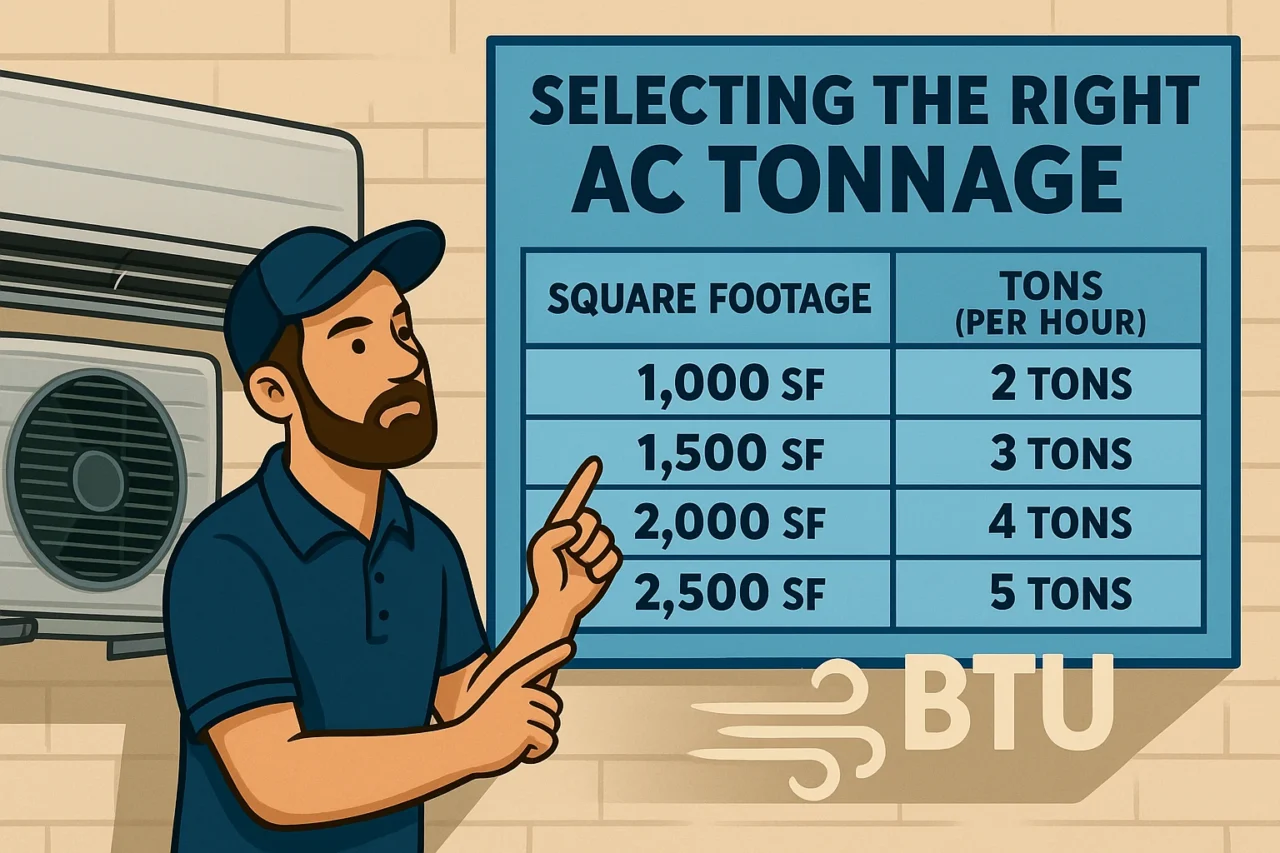
Picking the right AC tonnage is the single decision that sets how comfortable a Florida home feels and how much it costs to run. Tonnage is just the cooling capacity of the system – one ton equals 12,000 BTU per hour – and in this climate, getting it right matters more than almost anywhere else.
The common rule of thumb is one ton per 500 to 600 square feet. It is a useful starting point and a poor final answer. A home that runs the AC most of the year, against heavy humidity and a hot attic, needs the size matched to the actual load, not a chart.
Sizing is the one decision you cannot undo after the install. We measure it on site for homes across Florida.
What Size AC Do You Need for a Florida Home?
As a rough guide, sizing by square footage looks like this for a typical Florida home:
| Home size | Approx. tonnage |
|---|---|
| 1,000-1,200 sq ft | 2 to 2.5 tons |
| 1,200-1,700 sq ft | 2.5 to 3 tons |
| 1,700-2,200 sq ft | 3 to 3.5 tons |
| 2,200-2,700 sq ft | 3.5 to 4 tons |
| 2,700-3,200 sq ft | 4 to 5 tons |
Treat these as a ballpark. The real number shifts with ceiling height, insulation, window area and orientation, and how leaky the ductwork is in a 140-degree attic. Two homes the same size can need different tonnage once those factors are weighed.
Why Oversizing Is Worse Than Undersizing in Florida
Most homeowners assume a bigger AC is a safer bet. In Florida, the opposite is usually true.
An oversized system cools the air fast, then shuts off before it can pull moisture out of it. The thermostat reads the set temperature, but the house still feels damp and clammy because the unit never ran long enough to dehumidify. It also short-cycles, which wears the compressor and drives up the FPL bill.
An undersized system has the opposite problem – it runs constantly and still cannot reach the set temperature on the hottest days. Both extremes cost comfort and money, which is why the size has to match the load, not a guess.
How Many Tons Is My AC? Reading the Model Number
You can find your current tonnage on the outdoor unit’s data plate. Look in the model number for a two-digit figure that is a multiple of 6 or 12 – 18, 24, 30, 36, 42, 48, or 60. That number is the BTU capacity in thousands, and dividing by 12 gives the tonnage. A 36 means 36,000 BTU, or 3 tons.
Knowing your current size is useful, but it does not confirm it was right for the home. If comfort or humidity has been an issue, the existing tonnage may be part of the problem rather than the baseline to repeat.
Not Sure What Size You Need?
We run a proper load calculation on-site and size the system to your home – no oversizing, no guesswork.
The Manual J Load Calculation
The only accurate way to size an AC is a Manual J load calculation. It is the industry standard, and it accounts for the variables a square-footage rule ignores: insulation levels, window count and direction, ceiling height, sun exposure, air infiltration, and the condition of the ductwork. ACCA calls Manual J the national ANSI-recognized standard for equipment sizing loads, and notes that a load calculation under it is required by national building codes and most state and local jurisdictions. ENERGY STAR’s heat pump guidance makes the same point: undersized or oversized systems perform poorly, and the contractor should verify the size with a Manual J load calculation.
A proper AC installation always starts with one. If a contractor quotes a tonnage without measuring the home, they are guessing – and in Florida that guess usually lands on oversized. The right size keeps humidity in check, runs efficiently, and lasts longer.
Tonnage and Efficiency Go Together
Once the size is right, the efficiency rating decides the running cost. The federal minimum for Florida is 14.3 SEER2 for most residential split systems, roughly 15 on the older SEER scale, and DOE’s purchasing guidance for the hot-humid Southeast lists 15.2 SEER2 as the ENERGY STAR level. Stepping higher lowers the FPL bill over a cooling season that runs most of the year. The two choices work together – the correct tonnage running at a good SEER2 is what delivers a comfortable, affordable home. Our guide to the best AC unit for Florida covers how brand and efficiency fit the picture.
Have Us Size It Properly
We measure the house, check the ducts and the insulation, run the load calculation, and put the installation estimate in writing.
FAQ
What size AC do I need for a Florida home?
Start with roughly one ton per 500-600 square feet, so a 2,000-square-foot home usually lands around 3.5 tons. But ceiling height, insulation, windows, sun exposure, and ductwork all change the result, so a Manual J load calculation is the only way to get it right. Oversizing is a common and costly mistake here.
How many tons is my AC?
Check the outdoor unit’s model number for a figure that is a multiple of 12 – 24, 36, 48, and so on. That is the BTU capacity in thousands; divide by 12 for the tonnage. A 36 in the model number means 3 tons.
Is it better to oversize or undersize an AC in Florida?
Neither – but if forced to choose, oversizing is the bigger problem here. An oversized unit short-cycles and never runs long enough to remove humidity, leaving the house cold and clammy. The goal is a system matched to the home’s actual load.
How many square feet does a 3-ton AC cool in Florida?
Roughly 1,500 to 1,800 square feet as a starting estimate, depending on insulation, ceiling height, and sun exposure. A home with high ceilings or large west-facing windows may need more capacity for the same footprint.
Do I really need a load calculation?
Yes. Square footage alone misses the factors that drive cooling load in Florida. A Manual J calculation sizes the system to your specific home, which prevents the humidity and short-cycling problems that come from guessing. A professional sizing visit takes the guesswork out.