English
  Français
  Español
  Русский


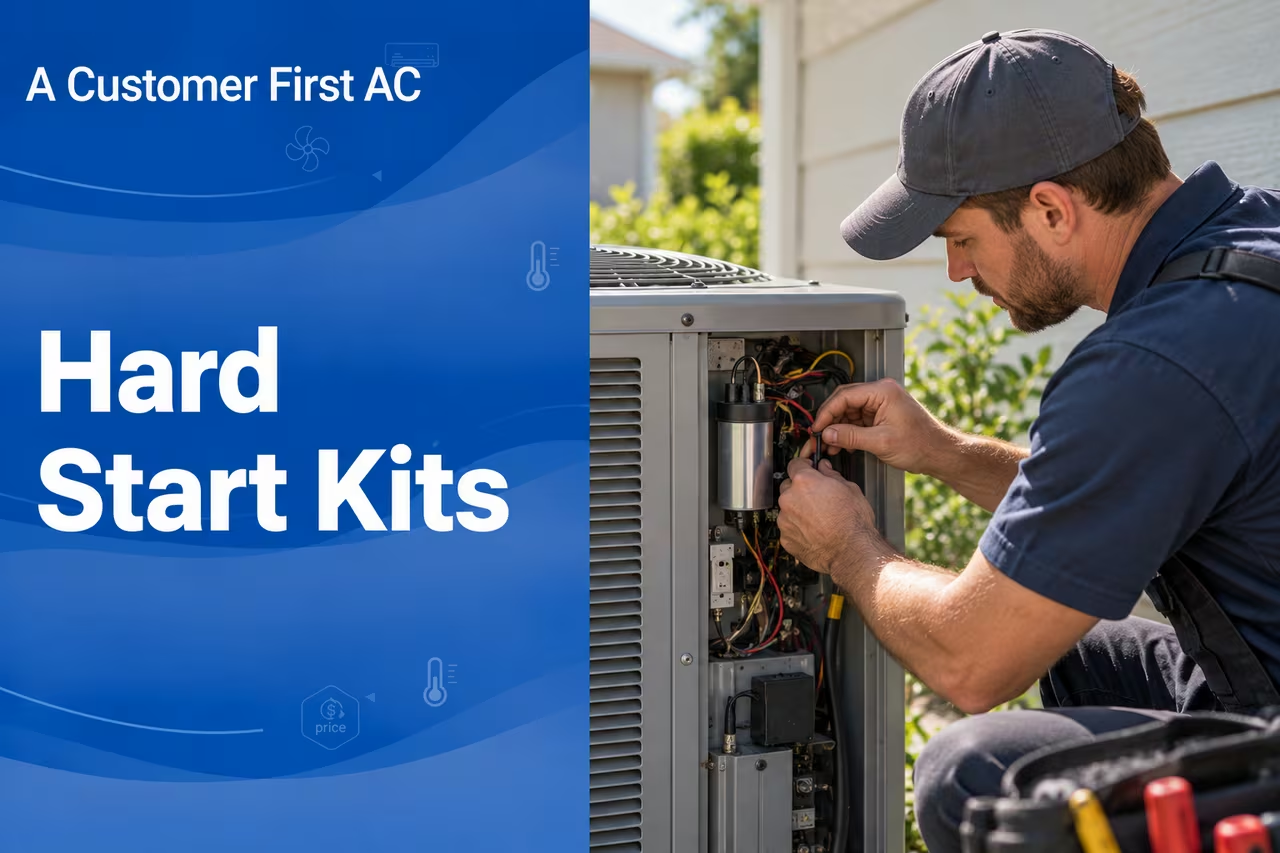
A hard start kit is a capacitor and a relay wired across the compressor's start circuit to give it a brief surge of extra torque at the moment it begins to turn. It does not make an air conditioner colder, quieter or more efficient. It solves one narrow problem: a compressor that draws heavily and hesitates when it tries to start.
That distinction matters because the part is sold both ways. In a South Florida service context it is a legitimate repair for a specific electrical symptom, and it is also the component most often added to a system that did not need it. Below is what the kit actually does, the symptoms that justify it, the ones that do not, and what a technician measures before recommending one.
What a Hard Start Kit Does Inside the Condenser
A single-phase compressor motor needs more torque to break away from a standstill than it needs to keep running. The run capacitor that lives in every condenser handles normal operation, but at the instant of startup it provides only a modest phase shift. Locked rotor amperage, the current the motor pulls in that first fraction of a second, can be five to eight times the running current.
The hard start kit adds a start capacitor with far higher microfarad value into the circuit, and a potential relay that drops it back out once the motor reaches roughly three quarters of running speed. The start capacitor is only in the circuit for a fraction of a second. If the relay fails to disconnect it, the capacitor overheats and fails, which is why a kit installed without matching the relay to the compressor is worse than no kit at all.
The common configurations are a three-wire potential relay assembly, and the sealed two-wire modules sold under names like the 5-2-1 compressor saver, the Supco SPP series and the Kickstart KS1. Two-wire modules install faster because they splice across the run capacitor terminals rather than requiring the relay to be matched to the compressor's back-EMF characteristics. That convenience is also their limitation, which the wiring section below covers.
The Symptoms That Actually Point to a Start Problem
Four signs, in combination, indicate a compressor struggling to start. One alone is rarely enough.
The outdoor unit hums for one to three seconds before the fan and compressor come up to speed, or hums and stops without starting at all. House lights dim briefly each time the system cycles on, because the motor is pulling locked rotor current for longer than it should. The breaker trips on startup rather than during a long run. The compressor starts reliably in the cool of the morning but hesitates in the afternoon, when head pressure is highest and the motor has more resistance to overcome.
That last pattern is the most diagnostic one in this climate. An afternoon-only failure in July that disappears by October is a start torque problem revealing itself under the exact conditions a Florida system faces ten to twelve months a year.
What does not point to a start problem: a system that starts instantly and then blows warm, a unit that runs continuously without reaching setpoint, ice on the line set, or water around the air handler. Those have other causes entirely, and a system that runs but does not cool is a separate diagnosis with a separate fix.
What Gets Measured Before the Recommendation
A start assist is prescribed from readings, not from a symptom described over the phone. The sequence a technician follows on arrival:
Readings that decide whether a kit belongs
- Run capacitor capacitance under load, compared with the printed rating and its tolerance band
- Locked rotor amperage at the moment of start, compared with the compressor data plate
- Running amperage against rated load amps once the motor is up to speed
- Voltage at the contactor during the start attempt, to catch a supply problem rather than a motor problem
- Winding resistance and continuity to ground, which separates a tired compressor from a failing one
- Head pressure, because a condenser that cannot reject heat makes every start harder
The voltage reading is the one most often skipped and the one that most often changes the answer. A compressor fed low voltage because of an undersized supply conductor, a corroded disconnect or a loose lug will hesitate exactly like a worn motor. Adding a start capacitor there treats a symptom while the real fault keeps degrading.
Coastal properties see this more than inland ones, since salt reaches terminals and lugs long before it reaches anything else. The same corrosion mechanism is covered in what salt air does to a coastal Florida system.
Why Starting Gets Harder in a Florida Summer
A compressor does not fail to start in a vacuum. It fails against the pressure it has to push into, and that pressure is a function of how well the condenser rejects heat.
Head pressure rises with ambient temperature, and it rises further when the condenser coil is fouled, when the fan motor has slowed, or when the unit sits where discharge air recirculates back through it. Every one of those raises the torque the motor needs at startup. A machine that starts cleanly at seventy-eight degrees ambient with a clean coil can hesitate at ninety-two with a coil carrying a season of lawn clippings and salt residue.
This is why a genuine diagnosis looks at the condenser before it looks at the start circuit. A coil rinse and a fan motor check sometimes remove the symptom entirely, at a fraction of the effort, and the process is described in how a condenser coil is actually cleaned. Installing a start assist onto a system with a blocked coil masks a restriction that will keep raising discharge temperature until something more expensive gives way.
Placement makes it worse. Condensers tucked into side yards between two houses, boxed behind hurricane shutters left closed, or screened by hedges that grew in over three seasons all recirculate their own discharge air. The unit reads a much hotter ambient than the thermometer on the porch. In older Broward neighbourhoods where lots are narrow, this is one of the more common findings on a start complaint, and the fix is clearance rather than components.
How Long a Start Assist Lasts and How It Fails
A correctly specified and correctly mounted kit is a multi-year part, not a consumable. When one fails early, the cause is almost always one of four things, and all four are avoidable.
Mounting against the compressor shell is the first. The capacitor sits in the hottest spot available and cooks.
The second is a relay whose dropout voltage does not match the compressor, leaving the start capacitor in circuit fractionally too long on every cycle until it overheats. The third is fitting a kit to a motor already drawing above rated load amps, where the underlying problem consumes the part. The fourth is moisture ingress at the splice, which on a coastal property is a matter of when rather than whether unless the connections are sealed.
Failure usually announces itself as a return of the original symptom: the hum comes back, the lights dim again. Occasionally a failed start capacitor takes the contactor with it, and the system stops entirely. Either way the correct response is to measure again rather than to fit an identical replacement, because a part that failed early was telling you something about the conditions it was working in.
Wiring: Two-Wire Modules Against Three-Wire Relay Kits
A three-wire potential relay kit is matched to the compressor. The relay has a pickup voltage and a dropout voltage chosen for that motor's back-EMF, so it removes the start capacitor at the correct moment every cycle. Done properly it is the more reliable of the two and the one used on larger residential compressors.
A two-wire module contains its own timing or current-sensing logic in a sealed package and connects across the run capacitor terminals. It fits almost anything, which is why it dominates retail. The tradeoff is that generic timing on a compressor whose start characteristics fall outside the module's design window can leave the start capacitor engaged slightly too long, cycle after cycle. On a system that starts many times a day through a Florida summer, that accumulates.
Neither type is a do-it-yourself job. The capacitors inside a condenser hold a lethal charge after the disconnect is pulled and must be discharged before anything is touched. Beyond the shock hazard, a miswired start kit can weld the contactor closed or destroy the run capacitor, and a contactor that will not open is its own failure mode, described in the contactor that stops half the systems we see.
Hearing a hum before your AC starts?
A hesitating compressor gets worse under Florida afternoon load, and the longer it draws locked rotor current the more winding insulation it loses. We measure before we prescribe.
Schedule a Free EstimateWhat a Hard Start Kit Will Not Fix
The part has a reputation it did not earn. Here are the claims that do not hold.
It will not lower your power bill in any amount you can measure. The start capacitor is energised for a fraction of a second per cycle. Whatever it saves is lost in the noise of a system that runs most of the year, and the residential energy data collected by the U.S. Energy Information Administration shows cooling load in hot-humid climates is driven by runtime and envelope, not by start events.
It will not rescue a failed compressor. If the windings are shorted or open, or the motor is grounded, no amount of start torque brings it back. A kit fitted to a compressor in that condition fails within days and costs a second service call.
It will not fix a refrigerant problem. A system low on charge behaves differently and needs the leak found, not more start torque. The signs of a system running low on refrigerant are distinct and worth recognising before a technician arrives.
It will not correct short cycling. A system that starts and stops repeatedly is responding to a control, airflow or sizing problem. Adding start torque lets it short cycle more comfortably while the underlying fault continues, and short cycling in a Florida system has its own causes worth reading separately.
When It Makes Sense on an Older Florida System
There is a genuine case for the part, and it sits in a narrow band: a compressor past its first decade that still tests electrically sound, draws close to but within rated load amps, and shows measurable start hesitation under afternoon head pressure. On that machine a start assist reduces the time the motor spends at locked rotor current, and locked rotor current is what cooks winding insulation.
The honest framing is that it buys time on a system that is aging, not that it reverses the aging. A household planning to replace within a season or two gets real value from a part that keeps the existing machine starting reliably until the replacement is scheduled on their terms rather than during a heat wave. A household with a system already showing other end-of-life signs is usually better served putting the money toward the replacement, and deciding between repair and replacement is the conversation to have first.
Voltage conditions in this region strengthen the case slightly. Summer afternoon demand across Broward and Miami-Dade pulls supply voltage toward the lower end of its tolerance at exactly the hour when head pressure peaks, and a motor that starts fine at nine in the morning can struggle at four. That is a real mechanism, not a sales line, and it is measurable at the contactor during a start attempt.
This might interest you: Compressor problems and what they sound like - how a struggling compressor differs from one that has already failed.
Hard Start Kit or Soft Start: Two Different Goals
The names sound like variations on one idea and they pull in opposite directions.
A hard start kit increases starting torque. It gets a reluctant motor turning by adding current briefly.
A soft starter reduces inrush current. It ramps the motor up over a longer interval so the peak draw is lower. That matters for generator backup, for solar systems with inverter limits, and for condominium buildings where electrical capacity per unit is constrained. It does not help a compressor that is struggling for torque, and on a genuinely hesitant motor it can make starting worse.
Choosing between them starts with the goal. Reduce electrical stress on a limited supply, and the soft starter is the part. Overcome measured start hesitation, and the hard start kit is. Fitting one where the other belongs is a common and avoidable error.
Installation, Standards and Who Should Do the Work
The work itself is short. Disconnect and lock out power, discharge the run capacitor, verify the compressor's electrical characteristics against its data plate, select a kit rated for that motor, mount it so it is not resting against the compressor body or in the path of the condenser fan's discharge, and route leads clear of hot surfaces and moving parts.
Mounting position is the detail most often done badly. A start capacitor strapped directly to a compressor that runs hot through a Florida summer will fail early, and every failure looks like a new fault to the next person who opens the panel.
The electrical standards governing motor start components and the conditions they are rated for sit with ASHRAE's technical resources for equipment applications, alongside manufacturer specifications for the specific compressor. Any technician opening a sealed refrigerant circuit on the same visit also needs EPA certification under Section 608, which is worth asking about when you compare who comes out to the call.
We handle these calls across Broward and into Miami-Dade, from Fort Lauderdale and Hollywood through Pembroke Pines, and the diagnosis is the same everywhere: measure first. Full details of how a repair visit runs are on the AC repair page.
When a Hard Start Kit Is the Wrong Answer
Three situations come up often enough to name.
A contractor proposes the part without taking a single reading. If nobody measured capacitance, locked rotor amperage and voltage at the contactor, the recommendation is a guess wearing a part number.
The kit is offered as an efficiency upgrade on a system with no starting complaint. There is no efficiency gain to collect, and a system that starts cleanly has nothing to assist.
The same system has needed one twice. A start assist that failed once may have been the wrong type or badly mounted. A second failure means something else is loading the motor, and the search moves to head pressure, condenser condition, supply voltage or the compressor itself. At that point the answer is a diagnosis, not a third capacitor.
Reading a Quote That Includes a Start Assist
When the part appears on an estimate, three questions separate a diagnosis from an upsell.
Ask what the run capacitor measured. A number and its rated value means the capacitor was tested. No number means it was not, and a weak run capacitor is the far more common cause of the same symptom.
Ask what locked rotor amperage was recorded at the start attempt, and how it compared with the compressor data plate. That single reading is the difference between a motor that needs help and a motor that is finished.
Ask what the voltage read at the contactor during that attempt. Low supply voltage produces the identical symptom and is not fixed by anything inside the condenser.
A technician who took those readings will have them. One who did not is recommending a part because the symptom sounded familiar, and that is how systems end up with a start kit, a new capacitor and a second visit for the fault nobody measured.
FAQ
What does a hard start kit actually do?
It adds a start capacitor and a relay across the compressor's start circuit, giving the motor extra torque for the fraction of a second it takes to begin turning. The relay drops the capacitor out once the motor reaches about three quarters of running speed. It changes nothing about how the system runs after that.
Will a hard start kit lower my electricity bill?
Not in any amount you can measure. The start capacitor is energised for a fraction of a second per cycle, and cooling cost in a hot-humid climate is driven by runtime and building envelope, not by start events. Anyone selling it as an efficiency upgrade is selling the wrong benefit.
How do I know whether my compressor needs one?
Four signs together: the outdoor unit hums for a second or more before starting, house lights dim briefly at each cycle, the breaker trips on startup rather than during a run, and the hesitation shows up on hot afternoons but not in the morning. Any one alone is not enough, and the readings decide.
What is the difference between a hard start kit and a soft starter?
They pull in opposite directions. A hard start kit raises starting torque to get a reluctant motor turning. A soft starter lowers inrush current so peak draw is smaller, which matters for generators, solar inverters and buildings with limited electrical capacity per unit. Fitting one where the other belongs is a common error.
Can I install one myself?
No. The capacitors inside a condenser hold a lethal charge after the disconnect is pulled and must be discharged first. Beyond the shock hazard, a miswired kit can weld the contactor closed or destroy the run capacitor, turning a small repair into a larger one.
My system needed a second hard start kit in two years. Is that normal?
No, and the second one is not the answer. A repeat failure means something else is loading the motor: high head pressure, a fouled condenser coil, low supply voltage or a compressor that is genuinely failing. The next step is a diagnosis, not another capacitor.
Is it worth fitting to a fifteen-year-old system?
Sometimes, with the framing understood. On a compressor that still tests electrically sound it reduces the time spent at locked rotor current, which is what damages winding insulation. It buys time on an aging machine so the replacement happens on your schedule rather than during a heat wave. It does not reverse the aging.