English
  Français
  Español
  Русский


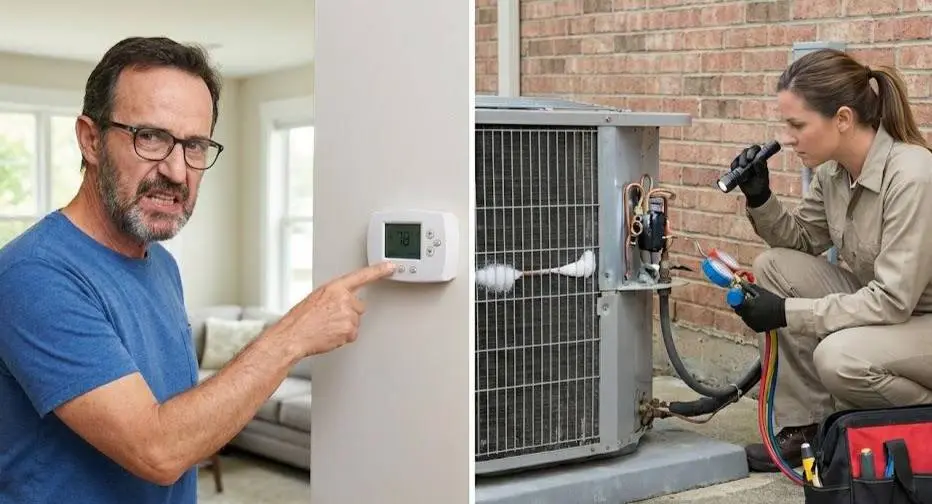
Refrigerant is what carries heat out of your home, and when the charge runs low, the whole system struggles. The important thing to understand up front is that an AC never uses up refrigerant in normal operation. If it is low, there is a leak – and topping it off without finding that leak only delays the same problem.
In Florida, a low charge shows itself fast because the system runs so much. Catching the early signs saves you from a frozen coil, a strained compressor, and a warm house in the middle of summer.
Signs Your AC Is Low on Refrigerant
Low refrigerant has a recognizable set of symptoms. One on its own might be something else, but two or three together point clearly to a low charge and a leak behind it.
Here is what to watch for.
Common low-refrigerant symptoms
- Warm or weak air from the vents
- Ice on the refrigerant line or the indoor coil
- A hissing or bubbling sound near the unit
- Longer run times with a higher FPL bill
- The house never reaching the set temperature
Warm Air and a House That Won’t Cool
The first thing most homeowners notice is that the air is not as cold as it should be. With less refrigerant to absorb heat, the system runs longer and still falls short of the thermostat setting. On the hottest days it can give up entirely and blow air that is barely cool.
That warm-air symptom overlaps with other faults, which is why it helps to look for the other signs alongside it. Our guide on why an AC blows warm air covers how to tell a refrigerant problem from the others.
Ice on the Line and a Frozen Coil
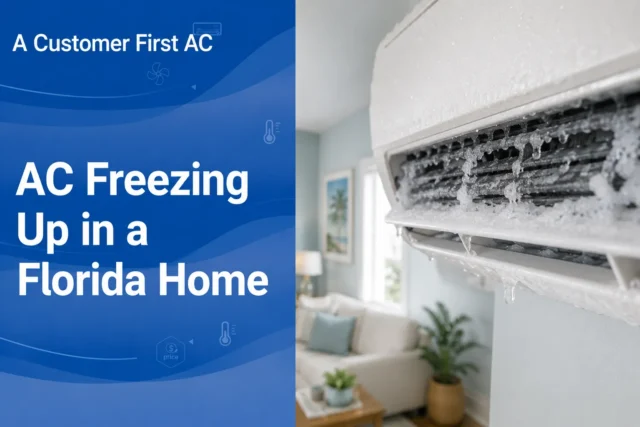
It sounds backward, but a low charge makes the coil colder, not warmer. The pressure drops, the coil temperature falls below freezing, and Florida’s humid air freezes onto it. You may see frost on the copper line running into the air handler or ice on the coil itself.
Once the coil freezes, airflow stops and the system shuts down until it thaws. If your AC keeps icing over, low refrigerant is one of the two main causes, alongside restricted airflow from a dirty filter or blocked vents.
A Hissing Sound
A hiss or bubbling near the indoor unit or the line set can be refrigerant escaping through a leak. It is easy to miss under the noise of a running system, but paired with warm air or ice, it is a strong sign the charge is dropping.
Think Your AC Is Low on Refrigerant?
We find the leak, seal it, and recharge to spec – not a quick top-off that fails again next month.
Why a Top-Off Is Not a Fix
Adding refrigerant to a leaking system is the most common shortcut in the trade, and it is the one that costs homeowners the most over time. The charge leaks back out, the symptoms return, and the underlying leak keeps growing. Each top-off is money spent to delay the real repair.
The lasting fix is a proper leak search and seal. Our refrigerant leak repair locates the leak, repairs it, evacuates the system, and recharges to the manufacturer’s spec – the procedure that actually ends the problem. It is also the lawful route, since under the EPA’s Section 608 program the Clean Air Act bans intentionally venting refrigerants while servicing or repairing air conditioning equipment.
What Happens If You Ignore It
A low charge does not fix itself. Left alone, the coil keeps freezing, the compressor runs hot trying to compensate, and what started as a small leak can end in a compressor failure – the most expensive repair on the system. Catching low refrigerant at the warm-air or ice stage keeps it a manageable repair.
FAQ
What are the signs my AC is low on refrigerant?
Warm or weak air, ice on the refrigerant line or coil, a hissing sound, longer run times with a higher bill, and a house that never reaches the set temperature. Two or three of these together strongly suggest a low charge and a leak.
Does low refrigerant mean my AC has a leak?
Yes. Refrigerant is not consumed in normal operation, so a low charge always means it is leaking somewhere – a fitting, the coil, the line set, or the compressor. The leak has to be found and sealed, not just refilled.
Why does low refrigerant cause ice on my AC?
A low charge drops the coil pressure and temperature below freezing, and Florida’s humid air freezes onto it. The ice blocks airflow and shuts the system down until it thaws, then the cycle repeats until the leak is fixed.
Can I add refrigerant to my AC myself?
No. Refrigerant handling is regulated and requires a licensed technician, and adding it without finding the leak is a temporary patch that fails. The correct fix is a professional leak search, seal, and recharge to spec.
How urgent is a low refrigerant charge?
Deal with it quickly. Running a low system freezes the coil and overworks the compressor, so a small leak left alone can grow into a major repair. Schedule a leak diagnosis when the early signs appear.