English
  Français
  Español
  Русский


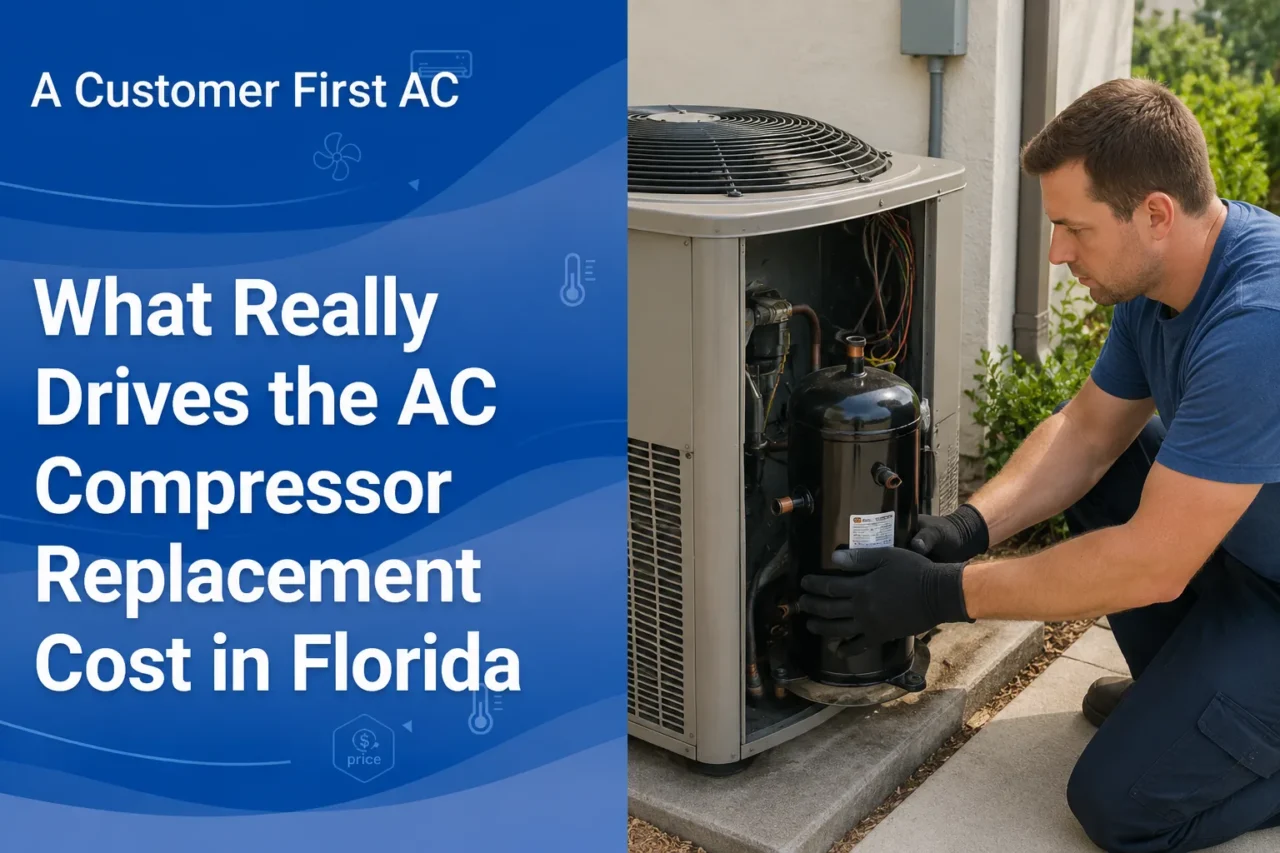
A failed compressor is the most expensive thing that can go wrong inside an AC, so the first question is almost always what the replacement will run. In Florida, that depends on more variables than most homeowners expect.
Two houses on the same street can get very different quotes for what sounds like the same job. The AC compressor replacement cost in Florida moves with your system’s size, its age, the refrigerant it uses, whether it is still under warranty, and the type of compressor going back in.
Below is what each of those factors does to the final number, when replacing just the compressor makes sense versus replacing the whole system, and the questions worth asking before you approve any work. If your unit is already acting up, start with the compressor problems we see most in Florida.
Why the Compressor Costs More Than Any Other Part
The compressor is the heart of the system.
It pressurizes the refrigerant and drives the whole cooling cycle, and nothing else in the unit does its job if it fails.
It is also a sealed, heavy component that sits deep in the condenser. Swapping one out is not a quick part change. A technician recovers the refrigerant, cuts into the sealed system, installs the new compressor, pulls a vacuum, and recharges, and that labor is a real chunk of the bill on its own.
The Factors That Shape Compressor Replacement Cost in Florida
No two quotes are built the same way. These are the variables that actually move the number, in the order they tend to matter.
System size and tonnage
A larger system needs a larger compressor, and a bigger compressor costs more as a part. A three-ton unit on a modest home and a five-ton unit on a large one are not in the same range, which is part of why quotes vary so widely across South Florida.
Single-stage, two-stage, or variable-speed
The kind of compressor matters as much as the size. A basic single-stage compressor is the least expensive to replace. Two-stage and variable-speed compressors cost more, because the technology that makes them quieter and more efficient also makes the part more expensive.
Refrigerant type
This is where Florida systems split into two groups. Newer units use R-454B, the refrigerant that replaced R-410A in new equipment starting in 2025.
Older systems on R-410A are still legal to service, but the refrigerant itself has gotten harder to source and more expensive since the phaseout. If your system is older still and runs on R-22, every refrigerant-related repair is pricier, and a leak alongside a compressor failure changes the whole calculation. A refrigerant leak repair is worth ruling out before anyone quotes a compressor.
Warranty status
This one can cut the bill in half or do nothing at all. Many systems carry a 10-year parts warranty, which can cover the compressor itself, but you still pay for labor and refrigerant, and those are not small.
System age and the repair-or-replace math
Age sits underneath every other factor. On a unit under about eight years old, replacing the compressor and getting years of service back is sound. Past ten or twelve years, you are putting one expensive new part into a system whose other components are also wearing out.
Got a Compressor Quote You Are Not Sure About?
We will diagnose the real problem, check your warranty, and give you a straight repair-or-replace answer before you spend anything.
When Replacing Just the Compressor Makes Sense
A compressor swap is the right move more than people think, but not always. The deciding factors are age, warranty, and history.
Replacing the compressor alone wins when the system is reasonably young, the part is under warranty, and it is the first major failure. You keep a system you already know, and you avoid the larger project of a full changeout.
It stops making sense when the unit is past a decade old, out of warranty, or already on its second or third repair. At that point the money is better spent on a new system, and our look at what drives AC replacement cost in Florida shows how those numbers compare.
Why Florida Is Harder on Compressors
A compressor in Ohio gets a break for half the year. One in South Florida does not.
Our systems run ten to twelve months a year against heavy heat and humidity, and near the coast, salt air corrodes the condenser the compressor lives in. That constant load is why compressors here tend to fail earlier than the same models up north, and it is the strongest argument for regular AC repair and service that catches small problems before they reach the compressor.
This might interest you: the early signs an AC is going out – catching them is what stands between a small repair and a full compressor failure.
FAQ
Is it worth replacing an AC compressor in Florida?
It depends on age and warranty. On a system under eight to ten years old with the compressor still covered, replacement is usually worth it. On an older, out-of-warranty unit, the money is often better put toward a new system that will last another decade or more.
Does a warranty cover compressor replacement?
Often the part, rarely the labor. Many systems carry a 10-year parts warranty that covers the compressor itself, but you still pay for labor and refrigerant. Always have the contractor verify coverage by serial number before any work begins.
How long does a compressor replacement take?
Most replacements are a same-day job, though a complex install or a hard-to-source part can stretch it longer. The work is labor-intensive because the technician has to recover refrigerant, open the sealed system, install the new unit, and recharge.
Can a bad compressor be repaired instead of replaced?
Sometimes the real problem is a failed capacitor, contactor, or hard-start component rather than the compressor itself, and those are far cheaper fixes. A proper diagnosis matters, because a compressor that has truly burned out has to be replaced, not repaired.
Why are R-410A systems more expensive to repair now?
R-410A was phased out of new equipment in 2025, and the refrigerant has become harder to source and more expensive since. Existing R-410A systems are still legal to service, but you may pay a premium on any repair that involves recharging. A system cannot be converted to R-454B, so the choice is repair as-is or replace.
How long should a compressor last in Florida?
Often ten to fifteen years, but the heavy local workload pulls that toward the lower end. Systems that get regular maintenance, and coastal units that are protected from salt corrosion, tend to reach the upper end of that range.