English
  Français
  Español
  Русский


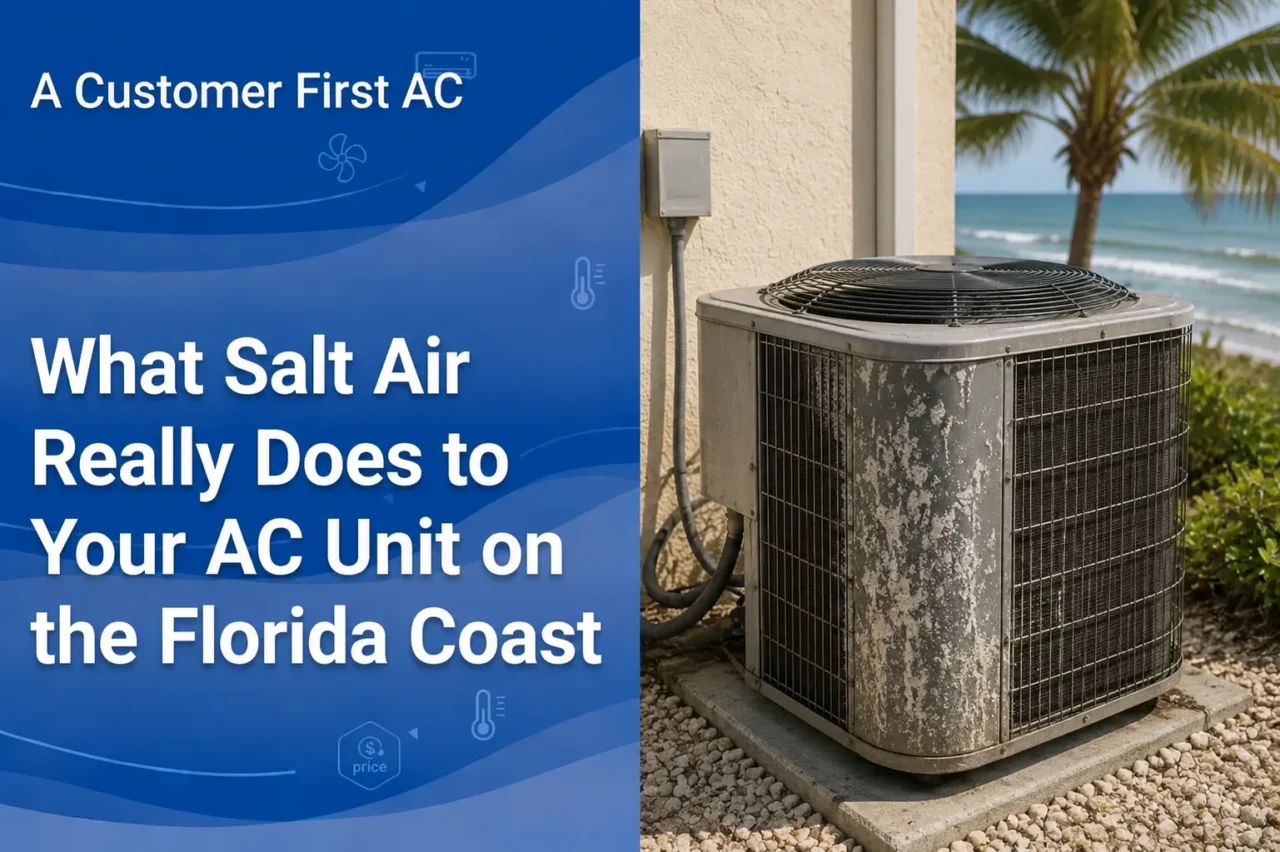
Salt air is one of the few things that wears out an AC faster than Florida’s heat does. Homes within a few miles of the water in Broward, Miami-Dade, and Palm Beach sit in air carrying fine salt that settles on metal and never fully washes away.
That salt is what turns a system built to last 12 to 15 years into one that quits in 7 or 8. Salt air damage to an AC unit on the Florida coast almost always starts outside, at the condenser, where the coil, the fins, and the electrical parts take the hit first.
Below is how the corrosion actually works, the warning signs we run into on coastal service calls, and what genuinely slows the damage down. If a coastal replacement is on your mind, our guide to which AC units hold up best in Florida pairs naturally with this one.
How Salt Air Attacks a Coastal AC Unit
Salt is hygroscopic. It pulls moisture straight out of humid coastal air and holds that moisture against whatever surface it lands on.
On an outdoor condenser, the result is a thin film of salty water sitting on aluminum fins and copper lines for most of the day. Metal under constant salt and damp does not stay intact. The protective surface breaks down, small pits open up, and corrosion works its way inward from there.
The condenser outside takes the worst of it for a simple reason: it pulls outdoor air through the coil every time the system runs. Every cooling hour drags more salt-laden air across the exact metal the unit is made of.
The condenser coil and fins
Corrosion on the coil is the damage that costs you money quietly. As the aluminum fins pit and flake, they stop transferring heat the way they should.
The system then runs longer and harder to hit the same temperature, which you feel on your FPL bill before you ever see the rust. Left long enough, corrosion eats through the thin coil walls and you get a refrigerant leak, which is a much larger repair.
Electrical contacts and the control board
Salt and moisture are rough on anything electrical. The contactor, relays, and wiring terminals corrode, and corroded contacts cause intermittent failures that are maddening to track down. A unit that runs fine one afternoon and refuses to start the next is a classic coastal symptom.
Signs Salt Air Is Already Wearing Down Your System
Coastal corrosion rarely announces itself. It shows up as small things that are easy to wave off until the system stops cooling on the hottest week of the year.
Here is what we look for first when we get a call from a home near the beach.
Coastal corrosion warning signs
- White or chalky buildup and rust-colored streaks on the outdoor unit
- Fins that look matted, flattened, or flaking when you look closely
- Longer run times and higher bills with no change in the weather
- The unit tripping off or failing to start on warm days
None of these are proof of a dying system on their own. Together, on a home a mile from the ocean, they usually mean the salt has been working on the metal for a while.
How Far From the Coast Does Salt Air Reach?
Salt does not stop at the beach. Onshore wind carries it well inland, which is why homes that feel nowhere near the water still see corroded units.
As a rough guide for Florida, properties within about a mile of open water take the heaviest exposure and need the most attention. The one-to-three mile band sees real but slower corrosion. Past that, salt is still in the air on breezy days, just at a level that behaves more like the rest of the state.
The closer you are, the more the maintenance math changes. A unit a block from the Intracoastal needs care a unit in western Broward simply does not.
Get a Straight Read on Your Coastal Unit’s Condition
We will check the coil, the fins, and the electrical side for corrosion and tell you honestly where your system stands – no pressure, no upsell.
What Actually Slows Coastal Corrosion Down
You cannot move the ocean, and you cannot make salt air harmless. What you can do is change how fast it works on your equipment.
Rinsing and real maintenance
Monthly rinsing handles the salt you can reach. Twice-a-year professional service handles the rest: a proper coil cleaning, an electrical check on the corroding contacts, and a look at refrigerant levels before a small coil leak becomes a big one. For coastal homes, our AC maintenance service runs on a tighter schedule than the standard once-a-year inland visit.
Corrosion-resistant equipment when you replace
When it is time for a new system, the coastal choice matters more than the brand name. Look for coil coatings, sometimes called e-coat or epoxy coating, that put a barrier between the salt and the aluminum.
Stainless steel fasteners and coated cabinets hold up where galvanized steel rusts through. Spending a little more here on a coastal AC installation buys years of extra life.
Smart placement and barriers
Where the unit sits changes its exposure. Keeping it out of the direct path of onshore wind, with a vented barrier that still allows full airflow, cuts how much raw salt spray hits the coil.
When to Repair vs. Replace a Salt-Damaged Unit
This is the question we get most on coastal calls, and the answer turns on where the corrosion is.
Surface rust on the cabinet is cosmetic. Corroded electrical contacts are usually a repair. The line that changes everything is the coil: once salt has pitted through the coil and the system is losing refrigerant, you are weighing a major repair against a unit that is probably past its best years anyway. If replacement is where you land, coil metal and coating decide how long the next one lasts, which is the heart of our Trane vs Carrier comparison for coastal Florida.
If your system is also getting on in age, replacement often wins on the math. Our breakdown of what shapes AC replacement cost in Florida walks through how those numbers come together, and a free estimate will tell you which side of the line your unit falls on.
This might interest you: how to clean a condenser coil the right way – the step that does the most to fight coastal corrosion between professional visits.
FAQ
Does salt air really damage AC units?
Yes, and the effect is measurable. Salt holds moisture against the metal of your outdoor unit, which corrodes the coil, fins, and electrical contacts faster than ordinary humidity does. Coastal units commonly fail years earlier than identical systems a few miles inland.
How often should I rinse my AC unit near the coast in Florida?
Once a month is a good rule within a mile of the water. Turn off the power at the disconnect, use a normal garden hose at low pressure, and rinse the salt off the fins. Skip the pressure washer, since it bends the fins and does more harm than the salt.
What kind of AC lasts longest on the Florida coast?
A unit with a coated coil and corrosion-resistant hardware. Coil coatings such as e-coat, stainless fasteners, and a coated cabinet are what keep salt from reaching the bare metal. On the coast, those features matter more than the badge on the front.
Can a corroded condenser coil be repaired?
Light corrosion can be cleaned and treated. Once salt has pitted through the coil and refrigerant is leaking, a repair rarely makes sense on an older system, and replacement is usually the better call. A technician can confirm which situation you are in.
How long does an AC last on the Florida coast?
Without coastal-specific care, salt can cut a system’s life to 7 or 8 years. With monthly rinsing, regular professional maintenance, and corrosion-resistant equipment, a coastal unit can reach the same 12 to 15 years you would expect inland.
Is a coil coating worth it for a coastal home?
For a home near the water, yes. The added cost at installation is small next to the price of an early coil failure, and a coated coil is one of the most reliable ways to push back against salt corrosion over the life of the system.